Questions about cricket id kyc documents usually arrive at the worst possible moment: money is sitting in a balance, a withdrawal has been requested, and somebody has just asked for a photo of an identity card. That timing is what makes the subject confusing. Verification is an ordinary part of how money moves, and it is also the exact moment a dishonest operation has the most leverage. Plenty of people reading this arrived at cricket accounts sideways after years of following football, where the paperwork conventions are more familiar and far more visible.
Most pages covering this topic are written to reassure you into handing documents over. This one is written to help you tell the difference between a routine administrative step and a request that should stop you cold. Nothing here recommends a place to play, and nothing here is advice on winning anything — real-money play is for adults only and losses are the expected outcome.
Table of Contents
Cricket ID KYC Documents Explained In Plain Terms
KYC stands for “know your customer”. It is a boring back-office process that exists wherever money is received from the public and paid back out again: banks, payment processors, brokerages, wallets, and any platform that holds a balance on someone’s behalf. The idea is simple. Before money leaves, the business wants documentary evidence that the person receiving it is the same real person who deposited it, that they are an adult, and that they only hold one account.
In the cricket-ID world the process looks different from a bank’s version, and that difference is the whole source of the confusion around cricket id kyc documents. A bank asks for proofs inside a branch or inside its own app, with a receipt, a reference number, and a named department. In the informal ID-reselling chain, the same request often arrives as a chat message from a personal account, with no reference number, no written policy, and nobody who can be identified if something goes wrong. The paperwork being asked for is the same. The accountability around it is not.
It helps to separate three things that get blurred together. The first is the requirement — verification as a concept, which is normal and widespread. The second is the channel — where and how the documents are collected, which is where almost all of the real risk sits. The third is the timing — when the request appears, which tells you a great deal about the motive behind it. Judging a request on all three, rather than only on the first, is the single most useful habit you can build.
Anyone used to following football accounts will recognise the shape of the first point and be caught out by the second. A large, well-known operation and an individual with a phone can ask for exactly the same document in exactly the same words. The words are not the signal. The structure behind them is.
None of this is about whether verification is a good or bad thing. It is about the fact that a copy of your identity document is a durable asset. Once a copy exists somewhere, you cannot recall it, and you have no way to audit who looks at it later. That asymmetry is the reason to think before sending rather than after.
Why Do Betting Sites Ask For ID Documents?
There are a handful of ordinary reasons a platform holding balances asks for proofs, and knowing them is what makes an unusual request for cricket id kyc documents stand out against the normal background.
- Age confirmation. Any operation handling real money from the public has a strong interest in being able to show that account holders are adults. A date of birth on a document is the standard way of doing that.
- Payout matching. When money leaves, the business wants the receiving name to match the account name. Mismatches are a common reason a withdrawal stalls, and a document is how the mismatch gets resolved.
- Duplicate detection. Multiple accounts created by one person cause problems with promotional offers and with internal accounting. Matching documents is how duplicates are spotted.
- Payment disputes. If a card or transfer is later challenged, the business wants a record showing who owned the account.
- Internal fraud controls. Accounts taken over by someone else are a real operational cost, and verification before payout is a crude but effective brake on that.
Notice what every one of those reasons has in common: they all protect the business and its payout process. That is not sinister, it is just the honest framing. Verification is not a service being done for you, and nobody should present it that way. It is a condition the business sets before releasing funds.
That framing is useful because it gives you a test. For each reason on the list, ask whether the party in front of you actually has the thing the reason refers to. Is there a payout process? Is there an accounting system that duplicate accounts would disrupt? Is there a dispute channel a record would be needed for? Where the answer is no across the board, the stated reason is decoration.
The flipside is equally honest: if the same documents are requested by someone who has no payout process at all, none of those reasons apply, and the request has no legitimate purpose. The checklist further down is built around spotting exactly that situation. If the signs in our breakdown of how to spot a fake cricket ID provider are already present before any document is mentioned, the verification request is not the first problem — it is the second.
What Documents Are Usually Needed For Betting KYC?
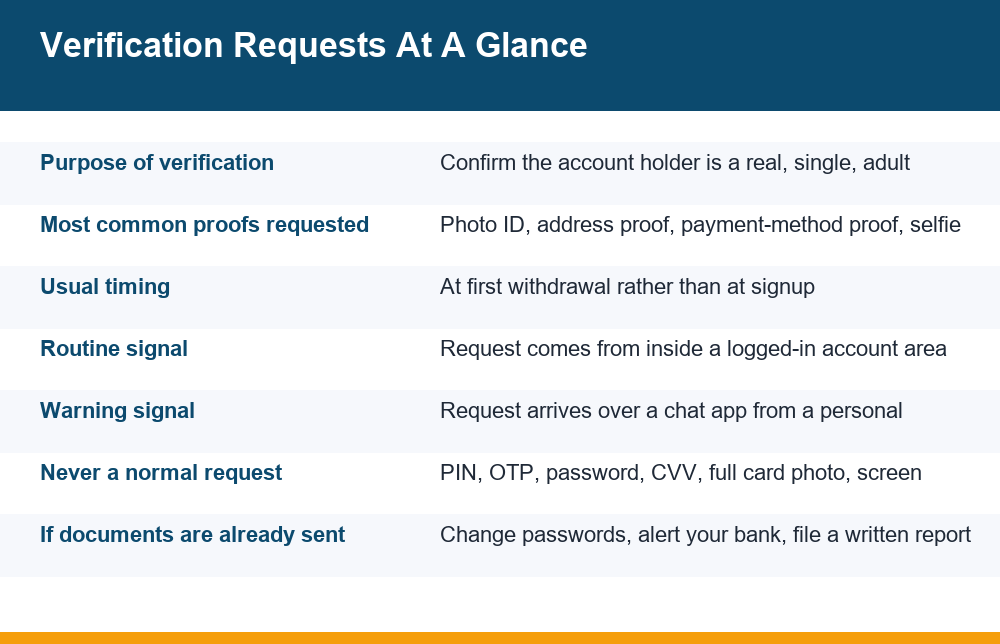
The set asked for under the heading of cricket id kyc documents is small and predictable. Across most money-handling businesses the request resolves to one proof of who you are, one proof of where you live, and one proof that the payment method belongs to you. Anything beyond that trio deserves a question.
| Type of proof | What it is checked for | Reasonable form |
|---|---|---|
| Photo identity | Name, date of birth, face match | A single clear image of one government-issued photo ID |
| Address | Residence matching the account record | A recent utility bill or statement showing name and address |
| Payment method | Ownership of the account money will reach | A statement header, or a screenshot showing name and partial number |
| Liveness selfie | That a real person holds the document | A plain selfie, sometimes holding the ID |
| Source-of-funds note | Unusual deposit patterns | A written explanation, occasionally a statement |
Two columns in that table matter more than the rest. The “reasonable form” column is the limit: a partial number, a single document, a plain image. A request that pushes past the reasonable form — the full front and back of a card, every page of a statement, a video call showing the inside of your banking app — is asking for far more than verification needs.
The middle column is worth reading alongside it, because it explains why the limit sits where it does. Each proof exists to confirm one narrow fact. An address proof confirms an address, which is why the transaction lines underneath it can be covered. A payment-method proof confirms a name and a last few digits, which is why the rest of the card is irrelevant. When a request cannot be mapped back to a single narrow fact, there is usually nothing on the other end that needed it.
What is never part of cricket id kyc documents
This list is short, absolute, and the most useful thing on the page. No verification process anywhere requires a password, a card PIN, a one-time passcode, a CVV, a UPI PIN, a screen-sharing session, or remote-access software installed on your phone. Those things do not prove identity. They transfer control. A request for any of them is not verification regardless of how it is explained, how urgent it sounds, or how plausible the rest of the conversation has been.
The distinction between proving and transferring is the whole of it. A document shows something about you that already exists and cannot be changed by the person reading it. A code or a PIN hands over the ability to act as you. No amount of explanation turns the second into the first.
A second category worth refusing is the “while you are at it” request: a family member’s document, a second ID in another name, or a document for an account you do not control. Those have nothing to do with verifying you.
Why Is Verification Often Asked Only At Withdrawal?
Signup is usually frictionless and withdrawal usually is not. The commercial logic is unglamorous: every extra step at signup costs conversions, and every extra step at withdrawal costs nothing the business minds losing. So document collection gets pushed to the point where the customer has the strongest reason to comply. That is why so many people first encounter the topic of cricket id kyc documents with money already on the line.
Understanding that timing is defensive knowledge, because it means a withdrawal-time request is not automatically a scam. It is the normal pattern, and it is also the pattern a dishonest operation imitates. The imitation is easy precisely because the real version looks the same from the outside.
What separates them is what happens after the documents are sent. A legitimate process has an end. Documents are reviewed once, the account is marked verified, and the payout proceeds. A harvesting process has no end. One document leads to a request for another, then a clearer photo, then a different document, then a small fee to “complete” the check, then a delay blamed on a department that is never named. Each step is individually small and each one is justified by the one before it.
The psychology of that chain is worth naming, because it is what makes otherwise careful people continue. Having already sent one document, the next one feels like a smaller decision rather than a larger total. The balance still sitting there pulls in the same direction. Treating each new request as if it were the first request, rather than as a continuation, is the mental habit that breaks the chain.
Delays on their own are not proof of anything either. Genuine backlogs exist, especially around major fixtures when everything slows at once — we cover that pattern in detail in our look at why withdrawals slow down during peak match traffic. The distinction to hold onto is between a delay with a stated reason and an end date, and a delay that keeps generating new requirements.
A practical rule: count the requests. One round of documents is normal. A second round for a genuinely unreadable image is believable. A third round, a new category of document, or any mention of a payment to release your own funds is the point at which the process has stopped looking like verification.
Routine Request Or Data Harvesting: A Checklist
This is the part the affiliate explainers leave out. Judging a request for cricket id kyc documents is less about the documents and more about the surroundings. Run through these before sending anything.
- Where did the request appear? Inside a logged-in account area with an upload form is one thing. A chat message is another.
- Is there a written policy you can read before you upload? A real process can tell you what is collected, why, and how long it is kept, without you having to ask.
- Is the requester identifiable? A named business, a contactable address, a support channel that exists independently of one person’s phone number.
- Did you get a reference or ticket number? Harvesting rarely bothers with one, because there is no process behind it.
- Is the list growing? Scope creep across messages is the clearest single signal.
- Is anything being asked that transfers control rather than proving identity? PIN, OTP, password, screen access — immediate stop.
- Is there a fee attached? Being asked to pay to unlock your own balance is not part of any verification process.
- Is urgency being manufactured? Deadlines, threatened account closure, and “the last person who delayed lost the balance” are pressure devices, not procedure.
You do not need all eight to be reassured, and you do not need all eight to walk away. Two or three failures on the identifiability and scope questions are enough. The cost of declining is a lost balance you may not have been going to receive anyway. The cost of complying with a harvesting operation is a copy of your identity in unknown hands, permanently.
It is worth running the checklist in writing rather than in your head, especially mid-conversation. Pressure works by keeping everything in short-term memory, where each individual request looks reasonable on its own. A written list is a record of what has already been asked, and that record is the thing scope creep cannot survive.
One more framing that helps: ask yourself whether you would send the same document, through the same channel, to a stranger who had contacted you first. If the answer is no, the fact that you opened the conversation does not change the risk. The channel is the risk.
The Chat Problem: Documents Sent Through Messaging Apps
The structural difference in this corner of the market is that a great deal of it runs over consumer messaging apps rather than over a website. That changes the risk profile of cricket id kyc documents in ways that are easy to miss, because the apps themselves feel private and familiar.
Consider what actually happens to a photo of an identity card sent in a chat. It lands in a conversation held on an unknown person’s personal device. Depending on that app’s settings, it may be saved automatically to the device’s photo library, and from there it may sync to a cloud backup under an account you know nothing about. It can be forwarded on without any trace visible to you. If that phone is sold, lost, repaired, or shared, the document travels with it. There is no deletion request you can file, because there is no organisation to file it with.
Compare that with an upload form inside an account area. It is not automatically safe — plenty of poorly-run sites handle uploads badly — but the document at least enters a system with a stated owner, a retention policy you can read, and a support channel that outlives any one individual. That is the practical gap between the two channels, and it is wider than most people assume.
There is also a second-order effect. A chat-based relationship means the person holding your document also holds your phone number, your messaging profile photo, your name, and a record of your activity. That bundle is worth considerably more than any single document, and it is the reason account hygiene matters as much as document hygiene. Our notes on keeping a betting account’s login and recovery details locked down cover the basic habits that limit the damage when one piece of a bundle leaks.
If a document genuinely has to be sent, a few small reductions help: send one document rather than a set, crop to only the fields being verified, add a visible watermark noting the date and purpose, and never send a document together with the payment details for the same account in the same conversation.
None of those reductions make a bad channel safe. They reduce how much a single leak is worth, which is a different and more modest goal. The only genuinely effective step is not sending the document at all, and that option stays open for longer than most conversations will suggest.
Can Identity Documents Be Misused By A Fake Provider?
Yes, and the honest answer has to include the shape of the misuse rather than just the word. A copy of an identity document and a matching address proof is the raw material for impersonation. The specific uses vary, but the pattern is consistent: the documents are used to make a second person’s activity look like yours. The risk attached to cricket id kyc documents is not abstract, but it is not mysterious either.
- Account opening elsewhere. Your proofs are used to register accounts on other services in your name, which you only discover when something goes wrong with one of them.
- Resale. Document sets have a market value and get bundled and passed on, which multiplies the number of people holding a copy.
- Targeted follow-up contact. Knowing your real name, address, and date of birth makes a later approach far more convincing, because the caller can recite details only a legitimate organisation should know.
- Recovery attacks. Date of birth and address are still used as identity checks in some account recovery flows, so a document set can be a route into accounts you care about far more than the one it was collected for.
- Mule-account paperwork. Documents are used to put a real identity on a payment account that is actually operated by someone else.
The uncomfortable feature of all of these is latency. Nothing visible happens for weeks or months, so the moment of handing over the documents does not feel like the moment of harm. By the time the consequence appears, the connection back to one chat conversation is hard to reconstruct, which is also why these cases are difficult to resolve afterwards.
That latency also distorts how people learn from it. Because no immediate consequence follows, the first few document handovers feel like evidence that the worry was overblown, and the habit gets reinforced rather than corrected. The feedback loop that normally teaches caution is simply missing here.
This is the honest case for caution, and it is not a dramatic one. It is simply that the downside is diffuse, delayed, and not reversible, while the upside of complying is a balance on a platform that may or may not pay out. That asymmetry does not require any exaggeration to be convincing.
Is It Safe To Upload Documents? Mistakes To Avoid
There is no answer to that question that applies to every case, because safety here is a property of the recipient, not of the act of uploading. What can be stated clearly is the set of mistakes that turn a manageable situation into a bad one. Every item below is a habit, not a judgement about any particular platform, and together they cover most of what goes wrong around cricket id kyc documents.
- Sending documents before any money is at stake. If verification is requested at signup over chat, before a deposit and before any balance exists, the request has no payout to attach to.
- Sending full card images. Verification of a payment method needs a name and a partial number. The full front and back of a card is not verification.
- Sending an uncropped statement. A full statement exposes your entire transaction history to confirm one line of it.
- Sending a second document because the first was “unclear”. Occasionally genuine. Repeatedly, it is a method.
- Treating a logo as identity. Branding is trivially copied. It establishes nothing about who is on the other end of a chat.
- Paying a fee to complete verification. There is no legitimate version of this.
- Reusing the account password anywhere else. A leaked document set plus a reused password is a far worse outcome than either alone.
- Sending documents and payment details in the same thread. Together they form a complete profile; separately they are much less useful to anyone.
- Letting someone talk you past your own rule. The pressure is the product. A rule you abandon under pressure was not a rule.
Most of those mistakes share a cause, which is deciding in the middle of a conversation. A rule written down before any request arrives costs nothing to follow and is almost impossible to argue with. A rule invented on the spot bends to whoever is talking.
If you want one sentence to carry away: verification requests should be boring. A boring request arrives inside an account, names what it needs, takes one round, ends, and never asks for anything that would let someone act as you. Anything that feels like a negotiation is not a verification process.
Step By Step: What To Do If Documents Are Already Out There
Most people reading about cricket id kyc documents are not deciding in advance. They have already sent something and are now uneasy. That situation is worth treating calmly, because there are useful steps even though the documents cannot be recalled.
- Stop the conversation rather than arguing with it. Do not send a further document to resolve a dispute about a previous one. Ending the exchange is the step that limits the total exposure.
- Write down what went where. Which documents, which channel, which phone number or handle, and on which dates. Screenshots taken now are worth more than recollection later.
- Change the passwords on anything important. Email first, then payment apps, then anything that shares a password with the account in question. Turn on two-factor authentication where it is available.
- Tell your bank or payment provider directly. Use the number printed on your card or inside the official app, never a number supplied in the chat. Flagging the account means an attempted misuse is more likely to be caught early.
- Watch for well-informed contact. A caller who already knows your name, address, and date of birth is not thereby legitimate. Knowing your details is exactly what a document set buys.
- File a written report. If you believe your identity documents or money have been misused, you can report it through India’s official National Cyber Crime Reporting Portal, keeping the acknowledgement reference for any follow-up with your bank.
- Keep a note of the outcome. If anything surfaces months later, a dated record of what you reported and when is the thing that makes it possible to explain.
That sequence will not undo a disclosure. What it does is shorten the window in which a document set is useful to someone and create the paper trail you would otherwise be missing. Both are worth the time they take.
One thing not to do is pay for a service promising to erase or recall the documents. Nothing of that kind can retrieve a copy that already exists on someone else’s device, and an offer to try is more often a second approach from the same direction than a solution to the first.
The closing thought is the same as the opening one. The request for documents is ordinary; the surroundings are what you are actually assessing. Verification that is real will still be there tomorrow and will not mind you reading the policy first. Verification that is not real depends entirely on you not pausing.
Frequently Asked Questions
Why do betting sites ask for ID documents?
The usual reasons are age confirmation, matching the payout name to the account name, detecting duplicate accounts, resolving later payment disputes, and slowing down account takeovers. All of those protect the payout process rather than the customer, which is the honest framing. The important consequence is that if the party asking has no real payout process, none of those reasons apply and the request has no legitimate purpose behind it.
Is it safe to upload my documents to a betting site?
Safety depends on the recipient and the channel, not on the act of uploading. A request inside a logged-in account area, with a readable retention policy and a support channel that is not one person’s phone number, is a different proposition from the same request arriving as a chat message. What can be stated flatly is that no verification process legitimately needs a password, PIN, OTP, CVV, screen sharing or remote access.
What documents are usually needed for betting KYC?
The standard set resolves to three things: one government-issued photo ID for name and date of birth, one recent address proof such as a utility bill or statement, and one proof that the payment method belongs to you, showing the name and a partial number. A plain selfie is sometimes added. Full card images, complete statements and documents belonging to other people are beyond what verification requires.
Why is verification often asked only at withdrawal?
Because friction at signup costs sign-ups and friction at withdrawal does not. Document collection is therefore pushed to the moment the customer has the strongest reason to comply. That makes a withdrawal-time request normal rather than suspicious on its own. The useful distinction is whether the process ends: one review and a completed payout is routine, while an endless chain of new documents, clearer photos and release fees is not.
Can my identity documents be misused by a fake provider?
Yes. A photo ID plus an address proof is the raw material for impersonation: opening accounts elsewhere in your name, resale of the document set, convincing follow-up contact from someone who can recite your real details, attacks on account recovery flows that still use date of birth and address, and putting a real identity on a payment account operated by someone else. The harm is usually delayed, which is why the moment of sending rarely feels risky.