Spotting a fake cricket id provider is not about recognising a face or a logo – it is about noticing that almost nothing in the arrangement can be checked by anyone other than the person taking your money. That is the single thing most pages on this subject get wrong. They describe scammers as an unlucky exception to an otherwise normal market, then point you towards a “trusted” alternative. This breakdown does the opposite: it names no platform, recommends no operator, and sticks to signals you can verify yourself before any money moves. Honest baseline first – this is 18+ territory, real-money play carries risk, and losses are the expected outcome of the margin, not bad luck.
Table of Contents
What Almost Every Page On This Topic Gets Wrong
Search this topic and the top results look like safety advice. Read them closely and most are marketing. The structure is almost always identical: a long section on how to recognise a fake cricket id provider, a list of frightening anecdotes, and then – in the final third – a contact number, a brand name, or a “verified” badge that the page awarded to itself. The warning section exists to make the recommendation at the end feel earned.
The practical consequence is that the red flags those pages list are curated. They mention the signs their own setup does not have, and quietly skip the ones it does. You will read a great deal about spelling mistakes, broken websites and rude behaviour. You will read almost nothing about the structural problems: that the account is not in your name, that the balance is a number someone else can edit, and that every term you agreed to was spoken rather than written.
The second mistake is framing. These pages treat the question as “which provider is genuine?” when the honest version is “what in this arrangement can I independently verify?” Those are different questions and they produce different answers. A friendly, responsive, well-reviewed contact can still be operating something you cannot check, trace or reconstruct afterwards. Politeness is not provenance, and a fast reply is not a record.
The third mistake is tone. Pages written to sell treat the risk as a solvable problem – pick the right contact and the danger disappears. That is not how it works. Choosing a more careful counterparty changes who you are dealing with; it does not change the structure of real-money play, where the margin means losses are the expected long-run result for the person placing the money. Any page that frames scam avoidance as the last obstacle between you and a profit is selling something, whatever else it says.
So treat what follows as a checklist, not a shortlist. Nothing here points you anywhere. Every item is something you can test from your own phone, before you send a rupee, and most of them take under ten minutes.
How A Fake Cricket ID Provider Actually Operates
The mechanics matter because they explain why the red flags cluster the way they do. In the common pattern, a fake cricket id provider does not build anything. It positions itself as a middle layer: you contact a number, you are quoted a figure, you send money, and you are handed a username and password to something you did not sign up for and cannot reset without asking.
That middle position is the whole business. Because the account was never created by you, it was never yours. There is no password recovery by email, no account-holder name, no statement, and no record linking the credit in that account to the money that left yours. The transfer that funded it typically went to a personal payment handle, not to a named business, so from the outside it looks like one individual sending another individual money for no stated reason.
The balance you see is the second layer. It is displayed to you, but it is administered elsewhere. It can be adjusted, frozen, reset, or simply made unreachable by changing a password you do not control. Nothing needs to be hacked or stolen for that to happen; the access was always one-sided.
People arriving from other sports often underestimate this because they are used to opening accounts in their own name. If you have mainly followed football markets, it is worth understanding first how cricket ID arrangements differ from the account structures football bettors are used to, because the differences are exactly where the risk sits.
The last layer is turnover. Numbers are cheap and disposable. A contact can be active for weeks, collect from dozens of people, go quiet, and reappear with a new number and the same script. That churn is why “he was fine last month” tells you very little, and why traceability – not reputation – is the thing to test.
The Nine Red Flags, One By One
Each of these is checkable. None requires you to be technical, and none requires you to trust a review site. Treat two or more appearing together as a reason to stop rather than to negotiate.
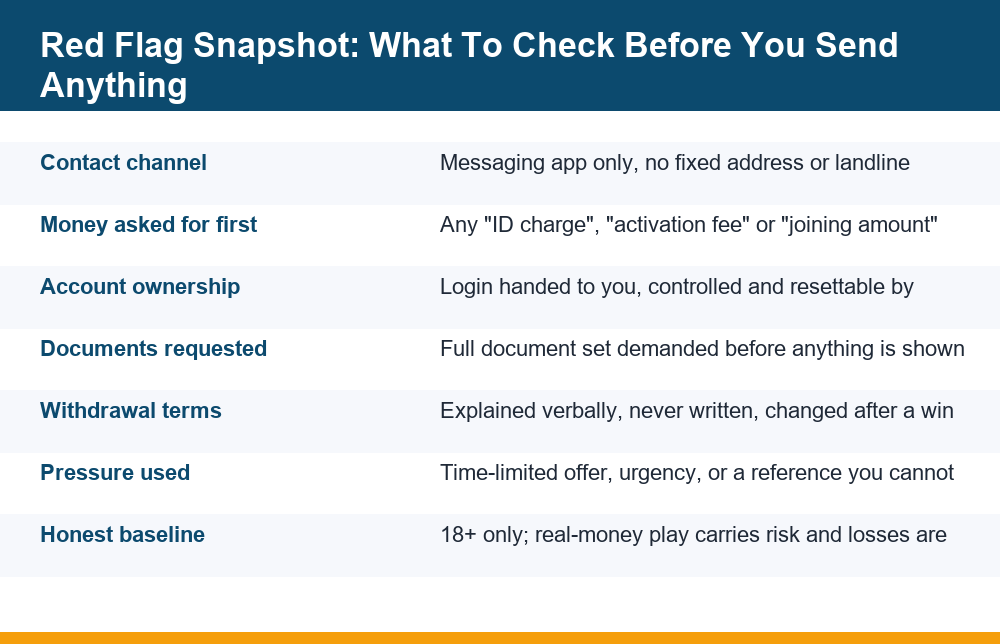
- Contact exists only inside a messaging app. No landline, no registered business name, no physical address you can look up independently. If the entire relationship lives in one chat thread, it can end with one block.
- Money is requested before anything is demonstrated. Any “ID charge”, “activation fee”, “joining amount” or “deposit to unlock” asked for before you have seen a working account is the clearest single signal on this list.
- The payment destination is a personal handle. Funds going to an individual’s payment ID or a personal account, rather than a named entity, remove the paper trail that would otherwise let you reconstruct what happened.
- The number has no verifiable history. A recently activated number, a recycled number with a mismatched profile photo, or a display name that has changed several times all point the same way.
- Terms are only ever spoken. Withdrawal minimums, commission cuts, turnover conditions and timelines are described in chat or on a call, never in a fixed document you can screenshot and hold them to.
- The login is handed to you rather than created by you. No email on file, no self-service password reset, no account holder name. You are a tenant, not an owner.
- Full documents are demanded early and without purpose. A complete set of identity documents requested before anything functions, with no stated reason and no handling explanation, is a data collection exercise.
- Pressure and scarcity appear in the pitch. Limited-time rates, “the slot closes tonight”, a bonus that expires in an hour, or a reference from someone you cannot actually reach.
- Terms change after the balance moves in your favour. A new condition that surfaces only when you ask to withdraw is not a misunderstanding. It is the design.
The reason this list is worth keeping in front of you is that the individual items feel small in isolation. An upfront fee can be rationalised as a service charge. A messaging-app-only contact can be rationalised as informality. It is the combination that is diagnostic, and the combination is what a fake cricket id provider produces almost inevitably, because every one of those nine traits reduces the chance of being traced.
Traceable Versus Untraceable: The Same Decision Seen Twice
The table below separates signals by whether they leave something behind. The right-hand column is not a list of “safe” options – nothing in real-money play is safe – but a list of signals that at least allow an account of events to be reconstructed later.
| What you are checking | Untraceable pattern | Pattern that leaves a record |
|---|---|---|
| Contact point | Messaging app number only, no fixed identity | Named entity with consistent public contact details |
| How you pay | Personal payment handle, cash, or crypto transfer | Payment to a named account with a reference you keep |
| Account creation | Credentials handed over by a third party | Account opened by you, in your name, with your email |
| Password control | Reset requires asking the seller | Self-service reset to your own email or number |
| Written terms | Spoken only, changeable at will | Fixed written terms you can screenshot before paying |
| Dispute position | No record that your money and the balance are linked | Transaction reference, timestamps and saved correspondence |
Read that table as one question repeated six times: if this goes wrong tomorrow, what evidence do I still hold? If the honest answer is “a chat thread with someone who can delete their account”, you already have your result.
The Upfront Fee Problem, Explained
The upfront fee deserves its own section because it is where most losses actually begin, and because it is the flag that provider-written pages are most careful to normalise. The pitch sounds reasonable: a one-time charge for setting up the account, a small amount compared with what you intend to deposit, framed as proof that you are serious.
Look at the structure rather than the amount. An upfront fee means money has moved in one direction before anything has been delivered, verified or demonstrated. It also means the amount at stake is small enough that most people will not pursue it – which is the point. A fee set low is not generosity; it is calibrated to the threshold below which people shrug and move on.
The second problem is that the fee establishes a pattern. Once one payment has gone through on trust, the next request lands in an established relationship rather than a cold one. Fees tend to arrive in sequence: a setup charge, then a minimum balance requirement, then a verification amount, then a release charge at withdrawal. Each is individually plausible and each is paid for the same reason – not wanting to abandon what has already been paid.
There is a useful test that costs nothing. Ask for the same figure in writing, with what it covers and what happens if the account never works, and ask for it in the chat rather than on a call. A request that cannot survive being written down is telling you something. In the pattern a fake cricket id provider follows, the answer tends to arrive as reassurance rather than detail, or as a voice note, or as a new reason the figure has changed.
That same escalation logic is what powers the follow-up approach after things go wrong, where a second contact offers to retrieve what the first one took. If you have already lost money this way, read about how recovery offers target people immediately after a loss before replying to anyone promising to get it back, because the recovery stage is frequently where the larger amount disappears.
The neutral position is simple and does not require judging anyone’s character: a request for money before anything exists is a request to carry all of the risk yourself. No answer to “why?” changes that structure.
Why Contact Stays Inside One Messaging App
People often read a messaging-app-only contact as casual rather than deliberate. It is usually deliberate, and understanding why makes the flag much harder to talk yourself out of.
First, a number is disposable in a way a business identity is not. It can be acquired, used, abandoned and replaced quickly, and nothing about the previous cycle follows it. Second, the conversation is private by default. There is no public thread, no visible complaint history, and no way for the next person to see what happened to the last one. Third, blocking is instant and total. One tap removes you from the only channel that existed, and nothing on your side changes to reflect it – your messages simply stop being answered.
There is also a persuasion effect. A chat thread with a profile photo, voice notes, cricket chat and quick replies builds a sense of a relationship that a form on a website never would. Responsiveness feels like accountability. It is not – it is simply attentiveness, and attentiveness is cheap when the account balance being discussed is a number someone can edit.
Group chats add another layer. Being added to a group where other members post wins, screenshots and thanks creates the impression of a crowd of satisfied customers, but every participant in that group is unverifiable to you. Names, photos and enthusiasm cost nothing to produce, and a group with two hundred members tells you nothing about how many of them are independent people. The only members whose experience you can assess are the ones you already knew before the group existed.
- Save your own copies. Screenshots of quoted terms, amounts and timelines live on your device, not in a thread someone else can delete.
- Note the number itself. Record the full number with country code before anything else happens; it is the one identifier you will need later.
- Treat voice-only terms as unagreed. If it was never written, it will not be remembered the same way by both sides.
- Watch for channel migration. Being moved to a second number or a new group mid-conversation usually means the first one is being retired.
- Discount group enthusiasm entirely. Posts from members you cannot independently reach are decoration, not evidence.
None of this makes messaging apps suspicious in themselves. The flag is not the app – it is the app being the only place the arrangement exists.
What Your Number And Documents Are Worth To Someone Else
The money is often not the only thing being collected. A phone number, a name, a document image and a payment handle together form a package with independent value, and a fake cricket id provider has every opportunity to gather all four during an ordinary-looking onboarding chat.
The straightforward misuse is contact. Your number becomes a confirmed, responsive contact who has already shown interest in real-money play and already demonstrated willingness to send money to a stranger. That profile travels. It explains why a single engagement is frequently followed by unrelated approaches from new numbers, group additions you did not request, and offers tailored closely to what you were previously discussing.
The more serious misuse involves documents. Identity document images are reusable. Once an image is sent into a chat, you have no control over where it is stored, how long it is kept, or how often it is forwarded. A genuine verification process has a stated purpose, a defined scope and an explanation of handling; an early, unexplained request for a complete document set has none of those things.
Sequence is the detail most people miss. A verification request that arrives before anything functions is doing something different from one that arrives at the point of a withdrawal, even if the documents named are identical. The first is collection dressed as process; the second at least has an occasion attached to it. Noticing when a request arrives is often more informative than arguing about what it asks for.
This is why it helps to know, in advance, what a genuine verification step actually asks for and when. A short read on which documents verification requests typically involve and when they are reasonable makes it much easier to notice when a request is out of sequence, oversized, or asking for something that has no bearing on the stated purpose.
The practical discipline is boring and effective: send nothing until you can state out loud why it is needed, who holds it, and what happens to it. If you cannot answer those three questions, the request is premature regardless of how routine it is made to sound.
When A Withdrawal Stops: What Is Really Happening
A blocked withdrawal almost never arrives as a refusal. It arrives as a delay with a reason, and the reason is designed to sound procedural. Understanding the sequence is useful because it is remarkably consistent.
Stage one is a condition you had not heard of: a turnover requirement, a minimum balance, a verification step, a waiting period. Stage two is a charge presented as unavoidable – a processing fee, a release charge, a clearance amount. Stage three is a second condition that appears after the first charge is paid. Stage four is slower replies, then a change of number, then silence.
The reason the sequence works is that each stage is small relative to the balance you believe you are protecting. Someone with a displayed balance they have mentally counted as theirs will pay a fraction of it to unlock it. But the displayed balance was never a holding of yours; it was a figure in an interface controlled by the person asking for the fee. Paying to release it is paying for a number.
The tone of the exchange usually shifts at the same time, and the shift is worth recognising. Early messages are quick, warm and accommodating. Once a withdrawal is requested, replies slow, explanations become vaguer, and responsibility moves to an unnamed third party – a payment partner, an admin, a settlement team – who is never reachable and never named consistently. Each of those is a way of adding a step without adding anyone you can speak to.
The only genuinely useful action at stage one is to stop paying. Not to argue, not to escalate inside the chat, and not to accept a partial settlement that requires a further transfer. Save what you have – the number, the payment references, the dates, the screenshots of quoted terms – and stop adding to the total. Every further payment increases the loss and improves nothing about your position.
It is also worth naming the uncomfortable arithmetic underneath all of this. Even where nothing deceptive is happening at all, the margin means losses are the expected long-run outcome of real-money play. A displayed balance moving in your favour is a moment in a distribution, not an asset – and treating it as an asset worth paying fees to protect is how a small loss becomes a large one.
Checking A Number Before You Engage: Step By Step
Verification is less satisfying than people hope. There is no single lookup that returns a verdict on a number, and anything claiming to offer one is usually monetising the search. What you can do is assemble weak signals until a picture forms, and refuse to proceed while the picture stays blank.
- Search the full number with country code as an exact phrase, in quotation marks, and then again without them. Note what appears – and note equally that nothing appearing is not clearance, only absence.
- Check the profile against the claim. A business presenting itself as established with a profile created weeks ago, or a display name that does not match the name used in conversation, is a mismatch worth weighing.
- Search the exact wording of the pitch. Scripts are reused verbatim across numbers. Pasting a distinctive sentence into a search box occasionally surfaces the same text under a different contact.
- Look for a verifiable identity, not a claimed one. Screenshots of testimonials, badges and payment confirmations are trivially fabricated and should carry no weight at all.
- Use an official reporting channel rather than a private warning. Telling your own contacts helps the people who already know you; a report in the right place is visible to everyone else.
On that last point, India’s national cyber crime reporting portal is the appropriate destination. Alongside its main complaint route it also offers a facility for submitting and checking suspect identifiers such as phone numbers, messaging-app numbers, payment IDs and website addresses, which is the closest thing to a central record that exists. The portal is at cybercrime.gov.in. Treat a result there the way you would treat any other weak signal: a match is worth taking seriously, and a clean result is not clearance.
Finally, accept what verification cannot do. A clean search does not establish that a contact is genuine; it establishes that nobody has published anything about them yet, which is the normal state for a number that was activated last month. This is why the structural red flags in this breakdown carry more weight than any search result. A fake cricket id provider is identified by what cannot be checked – no written terms, no account in your name, no traceable payment, no independent identity – and those absences are visible immediately, before any money moves and before any search is run.
If, after working through the nine flags, you find yourself constructing explanations for why each one does not apply in this particular case, that is itself the result. The checklist is not there to be argued with. It is there to be used before the deposit, which is the only point at which it costs you nothing.
Frequently Asked Questions
How do I know if a cricket ID provider is genuine?
You cannot establish it from behaviour, reviews or responsiveness – only from what is independently checkable. The questions that matter are whether the account is created by you in your own name, whether you control the password reset, whether the terms exist in writing before you pay, and whether the payment goes to a named entity rather than a personal handle. If all four answers are no, the arrangement is unverifiable regardless of how professional the contact seems. Screenshots of testimonials and “verified” badges are trivially fabricated and should carry no weight.
Why do cricket ID providers only use WhatsApp numbers?
Because a number is disposable, the conversation is private, and blocking is instant and total. A messaging number can be acquired, used and abandoned with nothing following it to the next one, which is why “he was reliable last month” tells you very little. There is also no public thread, so the next person cannot see what happened to the last one. Messaging apps are not suspicious in themselves – the red flag is the app being the only place the arrangement exists, with no fixed business identity, address or written terms anywhere else.
Should I pay an upfront fee to get a betting ID?
An upfront charge means money has moved before anything has been delivered, verified or demonstrated – you are carrying the entire risk. Look at the structure rather than the amount: fees are usually set low enough that most people will not pursue them, and a first payment made on trust makes the next request land inside an established relationship. These charges tend to arrive in sequence, with a setup fee followed by a minimum balance, a verification amount and a release charge. No explanation changes the underlying structure.
What happens if a cricket ID provider blocks my withdrawal?
It rarely looks like a refusal. The usual sequence is an unmentioned condition, then a charge to satisfy it, then a second condition after that charge is paid, then slower replies and a change of number. Each step is small relative to the balance you believe you are protecting, but that balance was always a figure in an interface controlled by the person asking for the fee. The only useful action is to stop paying, save the number, payment references, dates and screenshots, and add nothing further to the total.
Can a cricket ID provider misuse my phone number?
Yes, and your number is often valuable independently of the money. Engaging marks you as a confirmed, responsive contact who has already shown willingness to send money to a stranger, and that profile circulates – which is why one engagement is frequently followed by unrelated approaches from new numbers, unrequested group additions and closely tailored offers. Document images are worse, because once sent into a chat you have no control over storage, retention or forwarding. Send nothing until you can state why it is needed, who holds it and what happens to it.
How can I check a WhatsApp number for scam reports?
There is no single lookup that returns a verdict, and anything claiming to offer one is usually monetising the search. Search the full number with country code as an exact phrase and then without quotation marks, check whether the profile age and display name match the claim, and try searching a distinctive sentence from the pitch, since scripts are reused verbatim across numbers. Remember that nothing appearing is not clearance – it is the normal state for a recently activated number. India’s national cyber crime reporting portal also offers a suspect-identifier check, but treat a clean result there as absence of a report rather than reassurance.