Colour prediction predictor apps do not work, and the reason is simpler than any of their sales pages admit: each round of a colour game is drawn independently, so nothing about the last result changes the odds of the next one. As football fans we are used to form, injuries, home advantage and weather – real inputs that genuinely shift a probability. A colour round has none of that. There is no team news, no squad depth, no tired defence in the 85th minute. There is only a number drawn fresh each time.
That gap is exactly where the predictor industry lives: it borrows the language of analysis from sport, applies it to something with no analysable inputs at all, and sells the result at a monthly price. Below are five tests you can run yourself, in an afternoon, that every one of these tools fails – plus a breakdown of how the sellers get paid regardless of what happens to you.
Table of Contents
The Short Answer On Predictor Apps
No colour prediction predictor apps can tell you the next result. Not the free ones, not the paid ones, not the ones with a messaging channel and a wall of screenshots. The claim is unfalsifiable as it is presented, and falsifiable the moment you test it properly, which is why no seller publishes a timestamped, independently held prediction log.
That is the whole answer. Everything that follows exists because the sales pitch is sophisticated enough that “it does not work” feels like too thin a reply. The pitch borrows real vocabulary – algorithm, pattern recognition, signal, accuracy rate, AI model – and wraps it around a process that is equivalent to calling a coin toss. When you understand why that vocabulary cannot apply, you stop needing to evaluate each new app on its own merits. One explanation covers all of them, including the ones that have not been built yet.
There is a second, quieter answer underneath the first. Even if a predictor somehow called results better than chance, the structure of the game would still take money from players over time, because the payout on a correct call is set below the true odds of making it. That is the margin, and it is covered in detail in our breakdown of how the house edge works in colour prediction games. A perfect predictor fighting a built-in margin is still a losing position. An imaginary predictor fighting a built-in margin is two losses stacked on each other – the margin, plus whatever you paid for the app.
It is worth being clear about what this page is not. It is not an argument that a better tool exists somewhere, or that the right version of this idea has yet to be built. It is an argument that the category itself rests on a mistake about what a colour round is. That distinction matters, because the most common reaction to a debunking is to go looking for the one that is real.
One honesty line, and then we move on: these are 18+ real-money products, loss is the expected outcome rather than the unlucky one, and nothing on this page is encouragement to play.
How The Accuracy Claim Is Built
Understanding the mechanics of the claim matters more than arguing with the number. When a listing advertises a high accuracy percentage, that figure was not produced by a measurement. It was produced by a design decision – the app is built so that accuracy cannot be checked.
Three techniques do most of the work. The first is retrospective display. The interface shows you a history of past rounds with a prediction marker beside each one, and the markers agree with the outcomes. They agree because they were written after the outcomes were known. Nothing in the app ever stored a prediction before the round closed; the history is generated when the screen loads.
The second is hedged output. Instead of one call, the app gives you a primary and a backup, or a confidence band, or a “skip this round” signal. With enough hedging, almost every outcome can be read afterwards as a hit. Someone who says “home win, or draw, or skip if the odds move” has not predicted anything, and the same logic applies to colour prediction predictor apps that offer a safety option on every screen.
The third is survivorship in the testimonials. Hundreds of people are pointed at the same tool. By pure chance a handful of them will be up after their first few sessions. Those are the people whose messages get screenshotted into the promotional material. The far larger group who are down never appears, because nobody films a loss, and because the channel posting the material has no reason to.
Layered on top of all three is a presentation style borrowed wholesale from financial software: dark interfaces, live-looking charts, percentage readouts that tick, and a vocabulary of signals and confidence. None of it is connected to anything. A chart needs a quantity that varies meaningfully over time; a sequence of independent draws does not supply one. The visual language is doing persuasion work, not analytical work, and recognising that is usually the moment the whole thing stops being convincing.
- Retrospective markers – the prediction is written after the result is visible
- Hedged calls – a primary, a backup and a skip option cover nearly every outcome
- Survivorship – only the chance winners are quoted, never the much larger losing group
- Vocabulary borrowing – ‘algorithm’ and ‘AI model’ used where there is no input data to model
- Interface theatre – trading-style charts and tickers attached to data that cannot trend
- No raw log – the one artefact that could settle the question is never provided
Five Tests Colour Prediction Predictor Apps Fail
These are deliberately simple. None of them needs coding, maths beyond counting, or money spent. Each one isolates a single assumption the sales pitch depends on, and each can be run on any tool put in front of you without playing a single round for real stakes.
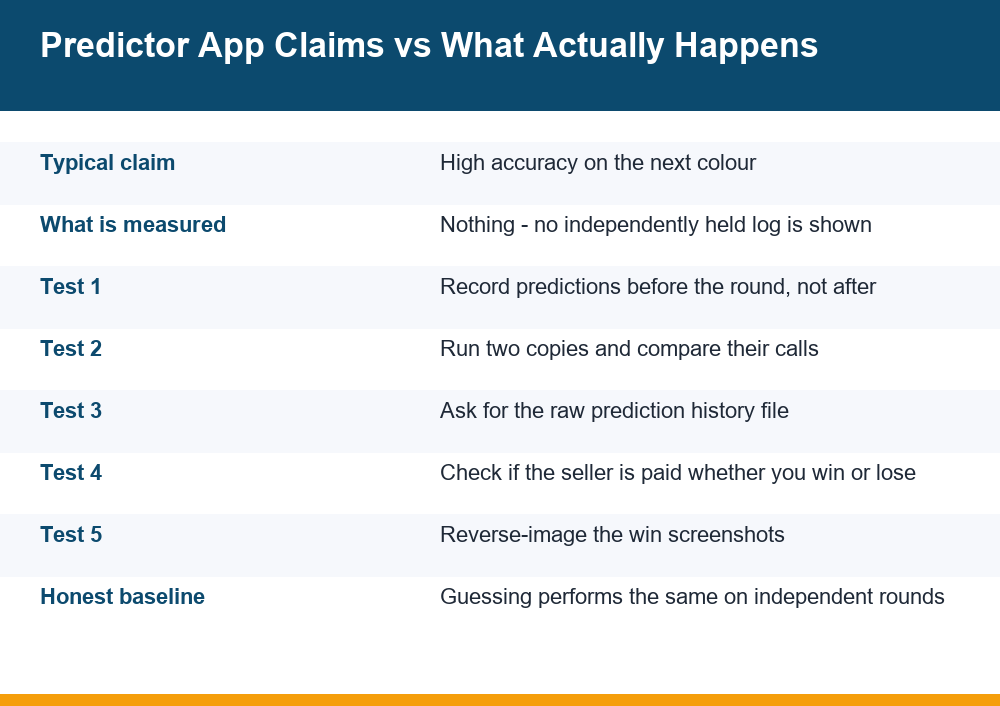
Test 1: Write the prediction down before the round
Open a plain notes file. Before each round opens, type the app’s call and the time. Do thirty rounds. Then compare. The point is not the hit rate – it is that the in-app history will not match your own notes, because the in-app history was rewritten. This single test ends most conversations about colour prediction predictor apps, and it costs nothing but half an hour.
Test 2: Run two installs side by side
Install the same app on two devices, or in two browser profiles, and read both at the same moment. A genuine model fed the same inputs returns the same output. If the two copies disagree on the same round, there is no shared model behind them – each copy is generating its call locally, which is to say guessing. Sellers sometimes answer this with talk of personalisation, which concedes the point: a forecast of a public event cannot differ per user.
Test 3: Ask for the raw history
Request the underlying prediction log as a file: every call, with a timestamp, for the last thousand rounds, including the ones the app got wrong. A real system has this, because it needs it to measure itself. Expect one of four replies – the log is proprietary, the log is only in the premium tier, a fresh screenshot instead of a file, or silence. The losing rounds are the ones that matter, and they are the ones that never arrive.
Test 4: Follow the money
Work out how the seller earns. Subscription, one-time unlock, referral commission on deposits, a paid channel, or a mix. Then ask what changes for the seller if you lose every round. In almost every case the honest answer is nothing, and that asymmetry is the tell.
Test 5: Reverse-search the proof
Take the win screenshots and run them through an image search. Look for the same image under different app names, different currencies, or an older date than the app’s launch. Also zoom in on the numbers themselves – edited balances frequently break font weight, digit spacing or the shadow under a figure.
| Test | What the pitch predicts | What actually happens |
|---|---|---|
| Pre-round log | Your notes will match the app history | The two diverge; app history was written after the fact |
| Two installs | Both copies give the same call | The copies disagree on identical rounds |
| Raw history file | Log provided on request | Proprietary, paywalled, or replaced with a screenshot |
| Seller economics | Seller needs you to win | Seller is paid the same whether you win or lose |
| Image search | Screenshots are unique and original | Same images reappear under other names and dates |
A note on sample size, because it is where well-meant testing goes wrong. Thirty logged rounds is enough to expose a rewritten history, since that is a yes-or-no question about whether two records match. It is nowhere near enough to measure a hit rate. On a two-way call, a run of twenty correct answers out of thirty happens by chance often enough that nobody should read anything into it. If someone wants to argue about accuracy rather than honesty, the sample has to be hundreds of rounds long and logged before the fact, which is precisely the artefact that never exists.
Why Independent Rounds Cannot Be Forecast
This is the load-bearing idea, so it is worth slowing down on. A colour round draws a value from a generator each time it runs. The generator is not consulting the previous draw. It has no memory of it, no obligation to balance it out, and no tendency to avoid repeating it. Each round is a fresh, self-contained event.
Compare that with a football match, where prediction is at least a coherent activity. A side missing two centre-backs, away from home, on a third game in eight days, genuinely is less likely to keep a clean sheet. The inputs exist, they are observable, and they connect causally to the outcome. You can be wrong about how much they matter, but you are reasoning about something real. We go further into that contrast in our piece on what football supporters get wrong about games of chance.
In a colour round there is no equivalent input. There is no fatigue, no form, no motivation, no crowd. The only data available is the list of previous results, and previous results carry no information about the next one. That is not a limitation of current technology that a better model will someday overcome. It is a property of independence itself. A model with nothing predictive to learn from cannot learn to predict, no matter how it is built or how much computing power is pointed at it.
It helps to state what a working forecast would actually require. You would need some quantity that exists before the round, that is observable to you, and that is causally linked to the value the round produces. In sport, all three conditions are routinely met in a loose, noisy way. In a colour round, none of the three is met at all. There is nothing to observe before the draw except earlier draws, and those are disconnected from it by design. A tool cannot bridge that gap, and no amount of interface polish disguises the fact that there is no bridge to build.
Two specific errors do most of the damage here. The first is the belief that a run makes a reversal overdue – six of one colour in a row does not make the other more likely on the seventh, because the generator never saw the six. The second is the belief that a long enough history must contain an exploitable pattern. Random sequences are full of streaks, clusters and apparent shapes; that is what randomness looks like up close. Finding a shape in past data and projecting it forward is the single mechanism behind almost all colour prediction predictor apps.
- The gambler’s fallacy – treating a streak as a debt the game must repay
- Pattern-finding in noise – every random history contains streaks that look meaningful
- Hindsight fit – a rule tuned on past data will always describe past data well
- Small-sample confidence – twenty rounds is not evidence of anything either way
- Category error – applying sport-style analysis where no causal inputs exist
Why Predictor Sellers Are Paid Either Way
The clearest way to see through the pitch is to stop asking whether the tool works and start asking how its seller gets paid. A tool that genuinely beat an independent draw would be worth vastly more than a monthly fee; its owner would simply use it. The decision to sell it instead, in volume, to strangers, tells you where the actual revenue is.
There are usually four revenue lines, and none of them depends on your outcome. Subscription or unlock fees arrive before any round is played. Referral commissions pay on deposits made through a tracked link, so the seller is compensated at the moment you fund an account – not at the moment you cash out. Upsells move disappointed users to a higher tier framed as the real version. And the sign-up list itself gets resold, which is why a single registration often produces contact from several unrelated channels within weeks.
The payment-first structure follows directly from this. Money has to change hands before the product can be evaluated, because the product cannot survive evaluation. Any request to pay an activation charge, an unlock fee, a verification amount or a processing cost before you see a single verifiable prediction is describing the business model out loud.
The same logic explains the churn. If revenue comes from new sign-ups rather than from satisfied users, the sensible strategy is a constant supply of fresh names and fresh audiences. That is why these tools appear, rename themselves and reappear so quickly, and why a channel’s follower count says nothing useful: reach is the asset being monetised, not performance.
The sign-up route deserves separate attention, because predictor promotion and account-reselling tend to travel together. Material pushing colour prediction predictor apps frequently routes users through intermediaries who handle registration on their behalf, which means credentials, payment details and personal documents pass through a third party with no accountability. We cover that pattern and its warning signs in our write-up on how account and login resellers actually operate.
How Win Screenshots Are Staged
Screenshots are the primary proof format, and they are also the easiest thing in this entire ecosystem to fabricate. Four methods account for nearly all of what circulates.
Direct editing. A balance figure is painted over in an image editor. The giveaways are typographic: a digit at slightly the wrong weight, uneven spacing where a wide numeral replaced a narrow one, a missing drop shadow, or a background gradient that steps instead of blending behind the edited number.
Browser inspection. On a desktop browser, any on-screen text can be edited live through developer tools and then captured. The result is pixel-perfect because nothing was painted – the page genuinely rendered that number for a moment. No amount of looking at the image will reveal this, which is why a clean-looking screenshot is not evidence of anything.
Demo and practice modes. Many interfaces offer a practice mode with fake credit. A screenshot from that mode looks identical to a real one once the small mode indicator is cropped out. Watch for images that are cropped unusually tight at the top or the corner.
Recycling. The same handful of images gets rotated between dozens of channels, with the app name swapped. This is why the reverse-image test is so productive: the proof behind two apps that have never heard of each other often turns out to be the same image file.
There is a broader point hiding in the detail. A screenshot of a balance is a picture of a number on a screen. Even a completely genuine one would show a single moment, chosen by whoever took it, with no record of the sessions either side of it. The format cannot carry the information that would matter – the full sequence, the amount staked, and whether anything was ever withdrawn – which is why it is the format of choice.
- Inconsistent digit weight or spacing in the balance figure
- A cropped top edge or corner, hiding a mode or account indicator
- Timestamps that do not match the stated date, or that repeat across ‘different’ users
- A currency or interface language that does not match the claimed user
- The identical image findable under another app name via reverse image search
- A large balance with no corresponding withdrawal record ever shown
What Provably Fair Actually Means
This phrase gets quoted in both directions – sometimes as reassurance that results are trustworthy, sometimes as evidence that the system is transparent enough to be decoded. Both readings miss what it describes.
A provably fair scheme is a commitment mechanism. Before a round, the operator publishes a cryptographic fingerprint of a secret value – a hash. The round runs using that secret combined with something the player contributes. Afterwards the secret is revealed, and anyone can re-hash it to confirm it matches the fingerprint published beforehand. If it matches, the secret was fixed in advance and could not have been swapped once stakes were in.
So the guarantee is narrow and specific: the result was not altered after the fact. That is all. It says nothing about the payout structure, nothing about the margin built into the odds, and – crucially for this page – nothing that helps anyone forecast a future round. The whole design depends on the secret staying hidden until after the round closes. If knowing it in advance were possible, the scheme would be broken rather than useful.
You will sometimes see provably fair language used as a selling point for colour prediction predictor apps, as though verifiability implied predictability. It implies the opposite. A verifiable commitment to an unknown value is a stronger statement that the value was genuinely unknown beforehand – including to anyone selling you a tool that claims to have known it.
| Question | Does provably fair answer it? |
|---|---|
| Was the result changed after stakes were placed? | Yes – that is exactly what it verifies |
| Can I verify a past round myself? | Yes, if the seed and hash are published |
| Does it tell me the next result? | No – the design requires the seed stay secret until after |
| Does it mean the odds are in my favour? | No – fairness of draw is not the same as favourable payout |
| Does it remove the built-in margin? | No – the margin is in the payout table, not the draw |
Is There A Pattern In The Results?
Yes, in the sense that you will always find one if you look hard enough – and no, in the sense that matters. This distinction is where most people’s reasoning comes apart, so it is worth separating carefully.
Take any sequence of independent draws and go looking for structure. You will find alternating runs, you will find clusters, you will find a stretch where one colour appeared six times in nine rounds. Human pattern recognition is tuned to be generous; it is far more willing to flag a shape that is not there than to miss one that is. Applied to a results history, it reliably produces the feeling of having spotted something.
The test for whether a pattern is real is whether it holds on data it was not derived from. Find your rule in the first five hundred rounds, then apply it, untouched, to the next five hundred. Overwhelmingly it will perform at chance. This is the ordinary problem of fitting a rule to noise, and it is not a flaw in your particular rule – it is what happens to every rule drawn from a history with no predictive content.
The same failure scales up rather than disappearing. Pointing more computing power at the history does not help, because the problem is not that the pattern is too subtle to find; it is that there is no relationship between past draws and the next one for any amount of searching to recover. A larger search simply finds more rules that fit the past and fail going forward.
Which is why the demand to make on any predictor is forward-only performance, logged before the fact, over a sample large enough to mean something. Backward-looking accuracy is free. Any system can be made to describe the past perfectly. Colour prediction predictor apps compete almost entirely on how convincingly they present that free, backward-looking fit.
Mistakes To Avoid And Where To Get Help
The costliest mistakes around these tools are rarely the subscription fee. They are the decisions the tool encourages once it has been believed.
The first is raising stakes on a high-confidence signal. Because the signal carries no information, the only thing that changed is your exposure. The second is treating a paid tool as a reason to continue after losses, since the money already spent feels like it needs recovering. The third is handing over personal documents, payment credentials or account access to whoever sold the tool – a risk entirely separate from whether the predictions are any good. The fourth is spreading it to friends, often through a referral link that pays the original seller, which turns a personal loss into a shared one.
- Never increase a stake because a tool called a round ‘high confidence’
- Never pay an activation, unlock or verification fee before seeing a logged prediction
- Never share identity documents, card details or account credentials with a tool seller
- Never treat money already spent on an app as a reason to keep playing
- Never pass a referral link to friends – the payment flows to the seller, not to you
- Never accept a screenshot where a raw, timestamped log was requested
If any of this is describing a pattern that has stopped feeling like a choice – chasing losses, hiding the spend, borrowing to continue – the useful step is support rather than a better tool. Free and confidential help, including a helpline and self-assessment resources, is available through GamCare’s get support pages, and equivalent national helplines exist in most countries. If money has already gone to a seller through a payment app or bank transfer, your bank’s fraud line is the place to raise it, and speed matters considerably in those cases.
The closing thought is a simple one. Colour prediction predictor apps are not a shortcut that happens to be unreliable. They are a product sold into a gap where no shortcut can exist, because the thing they claim to read is drawn fresh each round with nothing to read. Run the five tests on any tool that is put in front of you. They take an afternoon, they cost nothing, and they have never once produced a different answer.
Frequently Asked Questions
Do colour prediction predictor apps really work?
No. Each round is drawn independently, so past results carry no information about the next one – there is nothing for a model to learn from. The in-app accuracy figures come from histories written after the results were known, not from measured forward performance. Log the calls yourself before each round and the claimed hit rate does not survive.
Can you predict the next colour in a prediction game?
Not better than guessing. A forecast needs inputs that connect causally to the outcome, the way squad news connects to a football result. A colour round has no such inputs. The only data available is the previous results, and those are independent of the next draw, so any apparent edge is chance within a small sample.
Is there a pattern in colour prediction results?
You will always find one looking backwards, because random sequences naturally contain streaks and clusters. The test is whether a rule found in one stretch of history still works on a stretch it was not derived from. Applied forward to fresh data, these rules perform at chance – that is the signature of a pattern fitted to noise.
Why do prediction hack apps ask for payment first?
Because the product cannot survive evaluation, so payment has to arrive before you can check anything. Sellers also earn from referral commissions on deposits, upsells to a ‘real’ tier, and resale of the sign-up list – none of which depend on whether you win. Any activation, unlock or verification fee demanded before a single verifiable prediction is the business model showing itself.
Are colour prediction game results actually random?
The draws are generated independently of each other, which is the property that matters here: no round is influenced by the one before it, and no streak creates an obligation to reverse. Separately, the payout on a correct call is set below the true odds of making it, so the structure takes money over time regardless of how the draws fall.
What does provably fair mean in a prediction game?
It is a commitment mechanism. A cryptographic fingerprint of a secret value is published before the round and the secret is revealed afterwards, letting anyone confirm the result was not altered once stakes were in. That is its entire scope. It says nothing about the payout margin and nothing about future rounds – the design depends on the secret being unknown until after the round closes.