
You open an app during the half-time break, play a few hands of live blackjack, and by the time the second half kicks off you genuinely cannot say what the sitting cost you — which is the exact problem casino session spend tracking is meant to solve. Most football fans who drift into live tables between matches are not reckless. They are simply working without a number. Cash in a pocket shrinks visibly. A balance on a phone does not, and a live table deals faster than any sportsbook market settles.
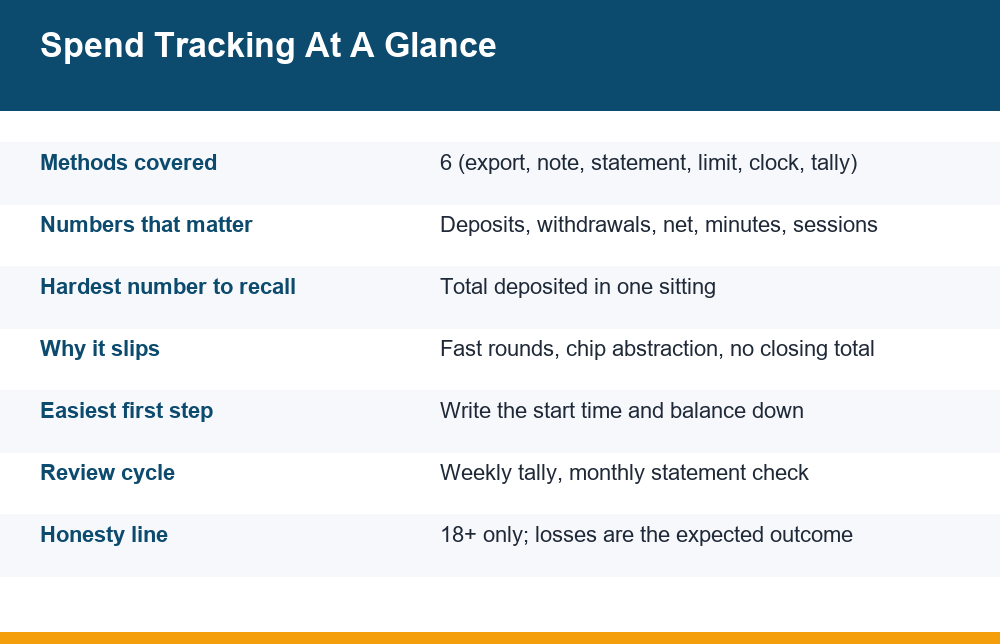
This breakdown covers why the format hides the total, what you should actually be measuring, and six concrete methods — transaction exports, a pre-session note, a monthly statement review, deposit limits, session time limits and a running tally — that give you a figure instead of a vague feeling. No tips, no systems, no recommendations: just the arithmetic. 18+ only, and losses are the expected outcome of real-money play.
Table of Contents
Why Live Casino Spending Feels Smaller Than It Is
Start with the clock, because speed is the single biggest distorter. A football accumulator resolves over ninety minutes or a whole weekend. You place it, you wait, you find out. A live roulette wheel completes a full cycle — betting window, spin, settle, new betting window — in well under a minute, and automated table formats move faster still. Twenty minutes of idle play between the final whistle and the next kick-off can contain thirty or forty separate staking decisions. Your memory does not store thirty decisions. It stores an impression: I played a bit.
The second distorter is abstraction. Chips, coins and credits are deliberately one step removed from money. A table that deals in 10-unit and 50-unit chips invites you to think in units, not currency. Some lobbies display a balance in a different denomination from the one your bank actually debited. None of this is hidden exactly — the conversion is always stated somewhere — but it adds a mental translation step, and under time pressure people skip translation steps.
The third is the absence of a closing total. A supermarket gives you a receipt. A card terminal shows a figure before you approve it. A live table session simply ends: you close the tab, the balance is whatever it is, and nothing ever presents you with a line that reads this sitting cost you X. You have to go and build that line yourself, which is precisely what the methods below do.
The fourth, and the one most specific to football fans, is framing. The session is mentally filed as a gap-filler, not as an activity in its own right. We looked at the same pattern in detail in this piece on how fans fill the gap between football matches with casino play, and the common thread is that incidental activities escape budgeting entirely. Nobody budgets for something they do not think of as a thing they did.
| What you notice | What is actually happening | Why the gap matters |
|---|---|---|
| “A few spins” | 30 to 50 separate stakes in 20 minutes | Round count, not session length, drives total stake |
| “I was using small chips” | Chip denomination is a label, not a currency | A 50-chip costs 50 of whatever the balance is in |
| “I topped up once or twice” | Several small deposits in one sitting | Deposits are the real spend figure, not visible balance |
| “I ended up roughly even” | Peak balance remembered, final balance forgotten | Recall tends to anchor on the best moment of the session |
| “It was just half-time” | Multiple short sessions across one match day | Four 15-minute sittings is an hour of play |
None of those five rows is a moral failing. They are predictable consequences of a fast, abstracted, receipt-free format. Which is why the fix is mechanical rather than motivational.
Casino Session Spend Tracking: What It Actually Measures
Before picking a method, decide what number you are after — because people chase the wrong one constantly. “How much did I lose” is a less useful question than “how much did I put in”, and both are less useful than the two together. Proper casino session spend tracking captures five figures, and only two of them are about money moving out.
- Total deposited — every top-up in the sitting, added together. This is the honest spend figure and the one most often underestimated.
- Total withdrawn — money actually moved back to your bank and left there, not money sitting in the account balance waiting to be played again.
- Net position — deposits minus withdrawals. A balance still in the account is not a win; it is unwithdrawn float.
- Minutes played — start time and end time. Time is the variable that predicts total stake better than anything else in fast formats.
- Number of sessions — four short sittings on a match day is one long session wearing a disguise.
Two of those will likely surprise you the first time you record them. Total deposited is usually higher than people guess, because small top-ups do not feel like separate events. Number of sessions tends to be higher too, because a sitting that ends and restarts twenty minutes later feels like one continuous thing in memory and two distinct events in the transaction log.
Note what is deliberately not on that list: win rate, return percentages, or any notion of whether you are “up” over some chosen window. Those invite the idea that the number can be managed into a better one. It cannot. The house margin is built into the rules of every game on the lobby, and no record-keeping changes it. Tracking is for knowing, not for improving outcomes.
Why a single honest figure beats a detailed spreadsheet
There is a real temptation, once you start, to build something elaborate — game-by-game breakdowns, hourly rates, variance columns. Elaborate systems tend to get abandoned within a few weeks. A single number per sitting, written somewhere you will see it again, survives. If you only ever record total deposited and the date, you are already ahead of nearly everyone playing between matches.
Pick the method you will actually repeat rather than the one that looks most rigorous. Consistency is what turns a pile of numbers into a readable pattern, and an imperfect record kept every week beats a perfect one kept twice.
Method 1: Pull And Keep Your Transaction History
Every account that holds money has a transaction log. On betting and casino accounts it generally sits under account settings, in a section called transaction history, account statement, payment history or something close. It lists deposits, withdrawals and often bonus credits with timestamps. This is the primary document, and it beats memory absolutely.
The practical steps are unglamorous. Open the account area rather than the game lobby. Find the history section. Set the date range wide — a full month, not a day, because the point is to see the pattern rather than the incident. Look for an export or download option, usually producing a CSV or PDF. If no export exists, screenshot the list or copy the rows into a note. Then total the deposit column.
- Open account settings, not the games lobby, and find transaction or payment history.
- Set the date range to cover at least the last full calendar month.
- Export to CSV or PDF if the option exists; screenshot or copy the rows if it does not.
- Sum the deposit column only — ignore in-game balance movements entirely.
- Sum the withdrawal column and subtract it from deposits to get your real net.
- Save the file somewhere outside the account so it survives a closed account or a lost login.
That last step matters more than it sounds. Access to your own history is not guaranteed forever. Accounts get closed, platforms disappear, logins get lost, and histories are sometimes trimmed to a rolling window. A copy you hold yourself is a copy that exists. Keep it in the same place you keep other financial records, and keep the raw export rather than a summary you typed up — the raw file carries timestamps that a summary loses.
One caution on reading these logs: deposit entries and gameplay entries are different things, and some platforms interleave them. If the log shows every individual bet, the row count will be enormous and the totals confusing. Filter to payment events — money in, money out — and let the rest go. Those two columns are the whole story.
If the export arrives as a CSV, open it in any spreadsheet tool and sort by type before you sum anything. Mixed-type rows are where most arithmetic errors come from, because a refund, a reversal or a transfer between wallets can look like a deposit at a glance. Sort first, sum second.
Method 2: The Pre-Session Note
The cheapest method on this list takes well under a minute and requires nothing but the notes app already on your phone. Before you start, write down three things: the time, the current account balance, and the figure you have decided is the stopping point. Then, when you stop, add the end time and the end balance underneath.
The reason it works is not discipline. It is that writing the number down creates a reference point your memory cannot quietly revise. Recall of a session tends to anchor on the peak — the moment the balance was highest — and treat that as roughly where things stood. A written start balance makes the peak irrelevant, because the comparison is now start against end, in text, with a timestamp.
There is a second-order benefit. The act of writing a stopping figure before you begin forces a decision while you are calm, rather than mid-session when the format is doing its best to keep you seated. Whether you honour it is a separate matter, but an undecided limit cannot be honoured at all. And if you find yourself reluctant to write the number down, that reluctance is itself information worth sitting with.
Keep the notes in one running file rather than a new note each time. After a fortnight you will have a list, and a list reads very differently from a series of individual entries. The pattern — how often, how long, how much — becomes visible in a way no single sitting ever is. This is where casino session spend tracking stops being bookkeeping and starts being useful.
One formatting detail makes the running file far more readable later: put the date first on every line, in the same format every time. Sorted lines group themselves by match day without any effort, and clusters — three entries on one Saturday, nothing for ten days, four on the next — are the thing you are looking for.
Method 3: The Monthly Bank Statement Review
Platform-side history tells you what happened inside one account. Your bank statement tells you what happened across all of them, and that difference is the entire value of this method. People who play on more than one site, or who switch sites over a year, routinely underestimate their total because each individual account’s history looks modest in isolation.
Open your banking app, go to statements, and read a full month line by line. Gambling-related debits usually carry a recognisable merchant descriptor, a payment processor name, or a merchant category code. Highlight them. Add them up. Compare the total to what you would have guessed before you started counting. The gap between the guess and the figure is the honest measure of how well your memory was doing.
Three things commonly turn up in this review that platform history never shows. Payments made through intermediaries or wallets, which appear under the wallet’s name rather than any recognisable site. Deposits made from a second card or account you had forgotten was linked. And fees or conversion charges attached to the transfers themselves, which are part of the spend even though no game was involved.
Do this monthly rather than daily. Daily checking turns into a nervous habit, and the monthly view is where seasonality shows up — which matters a lot for football fans specifically, since play patterns shift with the fixture calendar. The way activity creeps upward during quiet periods is covered in this breakdown of casino drift during the football off-season, and the monthly statement is exactly the instrument that makes that drift visible rather than theoretical.
Method 4: Deposit Limits As A Hard Ceiling
A deposit limit is an account-level cap on how much money you can move into a gambling account within a set period — commonly daily, weekly or monthly. You set it in your own account settings. Once it is active, deposit attempts above the cap are refused by the platform, regardless of what you decide in the moment. That is the point: it removes the decision from the moment entirely.
The mechanics are worth understanding before you rely on one. Reductions to a limit typically apply straight away, because lowering a ceiling is treated as protective. Increases usually involve a delay — a cooling-off period of some hours or days before the higher figure takes effect. That asymmetry is the feature that makes the tool worth anything at all, because an increase you can grant yourself instantly is not a limit.
Some other details that trip people up. A limit set on one account does nothing about any other account. Limits usually run on a rolling or calendar period, and which one you have changes when the counter resets. A limit caps deposits, not losses or stakes, so a balance already sitting in the account is outside its scope. And limits are set per currency or per wallet on some platforms, which means a single account can have more than one ceiling running at once.
- Set it low to start. A limit you never reach costs nothing; a limit set generously teaches you nothing.
- Check the reset period. Rolling seven days behaves very differently from calendar monthly.
- Expect a wait on increases. If the increase is instant, treat the tool as decorative.
- Remember it is per account. Multiple accounts need multiple limits, or the ceiling is fiction.
- Pair it with the statement review. The limit constrains; the statement verifies it actually did.
Used together with Method 1, a deposit limit also simplifies your own arithmetic considerably. If the weekly cap is a known figure and you reached it, your maximum weekly spend is that figure — no export required to know the ceiling, only to know where inside it you landed.
Methods 5 And 6: Session Time Limits And Clock Checks
A session time limit is a setting that tracks how long you have been logged in and playing, then interrupts you when a threshold you chose is reached. Depending on the platform it either displays a reality-check notice showing elapsed time and sometimes net position, or it ends the session outright. Reality-check intervals are commonly offered in fifteen, thirty or sixty-minute steps, though the available options vary.
Time is a proxy for spend, and in fast formats it is a very good one. If a game cycle takes forty seconds and you stake once per cycle, thirty minutes is roughly forty-five stakes whether you were paying attention or not. Capping minutes caps round count, and capping round count caps total stake far more reliably than any in-the-moment intention does. This is especially true of continuous-cycle games with no natural pause — the structural reason is laid out in this explainer on how crash-style games such as Aviator actually work, where the round is short by design and the next one starts without asking.
Method 6 is the manual version, for accounts without the setting: a phone timer. Set it before you start. When it goes off, the session is over — not after this round, not after this hand. The timer is crude and it works precisely because it is external. An internal intention to stop at some point competes with the game; an alarm does not compete, it just rings.
Running a weekly tally
Whichever methods you use, add one small habit on top: once a week, total the week. Deposits, withdrawals, net, total minutes, number of sessions. Five numbers, one line, same place every week. If you would rather work from a printed sheet than invent your own format, GamCare publishes a set of free self-help worksheets including a gambling diary that covers both time and money, and it asks for no account details of any kind.
The weekly line is where the whole exercise pays off, because a single sitting tells you almost nothing and twelve weeks of lines tells you everything. Trends are the readable unit. Individual sessions are noise.
Mistakes That Wreck Your Own Numbers
Most tracking failures are not laziness. They are specific, repeatable accounting errors that make the resulting figure wrong in a consistently flattering direction. These are the ones worth knowing about before you start.
- Counting net instead of deposits. “I only lost a little” measures outcome. Deposits measure the money you actually committed, and that is the figure your budget cares about.
- Treating balance as winnings. Money still in the account has not come back to you. Until it is withdrawn and stays withdrawn, it is float.
- Forgetting small top-ups. Three modest deposits in one sitting get remembered as one. The log disagrees, and the log is right.
- Counting bonus credit as money. Promotional balances carry conditions. Record them separately or not at all, never alongside cash.
- Tracking one account only. Multi-account play plus single-account tracking produces a figure that is wrong by design.
- Logging only the bad sessions. Selective records are worse than no records, because they feel authoritative while being skewed.
- Omitting transfer fees and conversion costs. They left your bank. They count.
- Backdating from memory. Reconstructing a fortnight after the fact produces a tidy, confident, inaccurate number. Record at the time or pull the export.
There is one more worth naming on its own, because it is not an arithmetic error. Any message, pop-up, agent or message-group offering to “recover” past losses, audit your account for a fee, or retrieve money on your behalf should be treated as a scam approach, full stop. Loss-recovery offers exist because accurate spend records are exactly what someone in distress does not have, and that information gap is the thing being sold back to them. Your own exported history is the only loss audit that is worth anything, and it costs nothing. Never hand over account logins, card details or one-time passcodes to anyone offering this, whatever credentials they claim.
Finally: if building these numbers feels bad, that reaction is data rather than a reason to stop. Spend tracking is not a performance metric and there is no score to defend. It is a measurement of money already spent, and knowing the figure is strictly better than not knowing it. Free, confidential support services exist in many countries for anyone who finds the figure troubling, and they are reached directly, not through any platform.
Common Questions Answered
Short answers to the questions that come up most often around casino session spend tracking, each expanded in the sections above.
Does tracking change my results?
No. Record-keeping has no effect on game outcomes, and no amount of data reveals a pattern that overcomes the built-in house margin. Every game on a casino lobby is designed so that losses are the expected long-run outcome. Tracking tells you what the activity cost. It does not and cannot make it cost less.
How long before the records are useful?
About four weeks. A single session is unreadable noise. A month of weekly lines shows frequency, typical duration and typical deposit size — the three things that actually describe a habit. If you only commit to one thing, commit to four weeks of honest lines and then read them.
What if the figure is higher than I expected?
That is the usual result, and it is the point of measuring rather than guessing. A higher-than-expected number is not a verdict on you; it is the gap between an abstracted format and ordinary memory, which is exactly what the distorters above predict. What you do with the figure is a separate decision, and having it is the only thing tracking was ever going to achieve.
Frequently Asked Questions
How do I track how much I spend in a casino session?
Record five figures per sitting: total deposited, total withdrawn, the net difference, minutes played, and whether it was one session or several. The reliable source is your account’s transaction or payment history, which you can usually export as a CSV or PDF — sum the deposit column only and ignore in-game balance movements. Supplement that with a quick pre-session note on your phone recording the time, the starting balance and your stopping figure, then the end time and balance when you finish. Once a week, total the week into a single line. Deposits, not net losses, are the honest spend figure, and they are the number most often underestimated.
Why does live casino spending feel smaller than it is?
Four reasons stack up. Speed: a live table completes a full cycle in under a minute, so twenty minutes can contain thirty to fifty separate staking decisions, and memory stores an impression rather than a count. Abstraction: chips, coins and credits sit one translation step away from currency, and under time pressure people skip the translation. No receipt: a session simply ends, and nothing ever presents you with a closing total, so you have to build that line yourself. Framing: play that fills a gap between matches is filed mentally as incidental, and incidental activities escape budgeting entirely.
How do I check my betting transaction history?
Open the account settings area rather than the games lobby and look for a section named transaction history, account statement or payment history. Set the date range to cover at least a full calendar month, then export to CSV or PDF if an export option exists, or screenshot and copy the rows if not. Filter to payment events — money in and money out — rather than individual bet entries, which will otherwise swamp the list. Save the file somewhere outside the account, because access to your own history is not permanent: accounts close, logins get lost, and histories are sometimes trimmed to a rolling window.
What is a deposit limit on betting sites?
It is an account-level cap on how much money you can move into a gambling account within a set period, usually daily, weekly or monthly, which you set yourself in account settings. Deposit attempts above the cap are refused. Reductions normally take effect immediately, while increases involve a cooling-off delay before the higher figure applies — that asymmetry is what makes the tool meaningful. Key limitations: a limit applies only to the account it was set on, it caps deposits rather than losses or stakes, money already in the balance sits outside its scope, and the reset period may be rolling or calendar-based.
What is a session time limit in online casinos?
A setting that tracks how long you have been logged in and playing, then interrupts you at a threshold you chose — either showing a reality-check notice with elapsed time and sometimes net position, or ending the session outright. Intervals are commonly offered in fifteen, thirty or sixty-minute steps, though the choices vary by platform. Time works as a proxy for spend because in fast formats round count scales directly with minutes played, so capping minutes caps total stake more reliably than in-the-moment intentions do. If your account lacks the setting, a phone alarm set before you start does the same job, and works precisely because it is external to the game.