A betting loss recovery scam is not a sequel to whatever happened the first time, but a separate operation, run by different people, that treats your loss as the raw material for a new approach. That distinction matters more than anything else on this page. Most of what you will read elsewhere on the subject is written either by the people selling recovery services or by pages that lump the whole thing in with the original loss, as if one explanation covers both. It does not.
As a football-first site that ends up writing a great deal about cricket IDs and chance-based apps, we see this pattern land on people who are already embarrassed, already out of pocket, and already half-convinced that one more payment will square the books. What follows is a plain breakdown of how the approach starts, why the fee always comes before the refund, and what the honest answer to “can it be recovered” actually looks like.
Table of Contents
Why Most Pages On The Betting Loss Recovery Scam Miss The Point
Here is the single thing nearly every page on this topic gets wrong: they frame the second approach as a continuation of the first. The story goes that a shady app took your money, and now the same operation is circling back for a second bite. Sometimes that is true. Far more often it is not, and believing it is the reason people get caught.
The betting loss recovery scam does not need your original loss to have been dishonest at all. It works perfectly well on someone who simply lost a bet. The margin built into a chance-based product means losing is the ordinary, expected result, not evidence of anything going wrong. A recovery approach does not care about the difference. All it needs is a person who recently lost money and said so somewhere another person could read it. The loss is the qualifying signal, nothing more.
The second blind spot is who writes about this. Search the subject and a large share of the results are published by outfits offering recovery services, which means the page explaining the scam is itself the pitch. They will describe a crude version of the approach, with bad grammar and obvious fake logos, and then position themselves as the credible alternative. That framing is useful to them because it moves the question from can this be done at all to who should I pick. The honest answer sits at the first question, and almost nobody wants to publish it.
The third thing missed is the emotional mechanism. This is not an approach that relies on greed, and that is exactly why it slips past people who consider themselves careful. It relies on the desire to undo something. Someone who has just lost money they could not spare is not evaluating an opportunity; they are being offered a way to make the last month not have happened. Those are very different states of mind, and the second one is far easier to work with.
There is a practical consequence to getting this framing right. If you believe the second approach can only come from the people behind the first, you will judge the message by what you think of that app. You will reason that you used a well-known product, or that you were careful about where you deposited, and therefore the person contacting you must be genuine. That reasoning has no load-bearing part. The approach is built around your loss, not around any particular platform, and the sender almost never has any connection to the place where the money went.
What Is A Betting Money Recovery Scam?
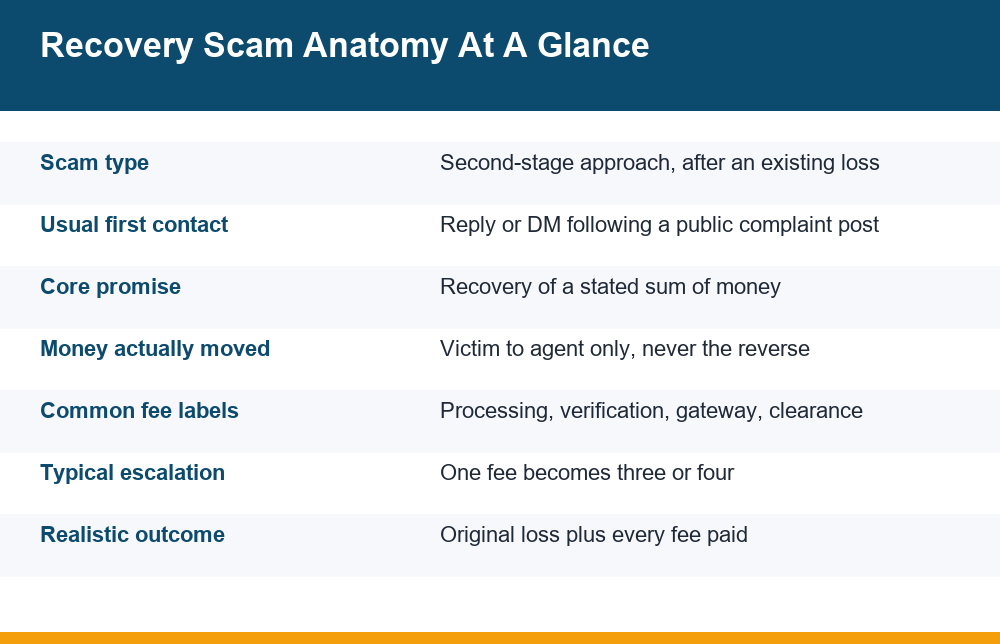
A betting money recovery scam is an approach in which someone contacts a person who has lost money on a betting or chance-based app and offers, for a fee, to retrieve it. The offer is framed as a service: they have access, a contact, a panel, a technical route, a dispute process. What is actually being sold is the fee itself. There is no retrieval step at the end of the process, because the process is the product.
The structure is consistent even when the surface details change. First comes contact, usually unsolicited. Then comes a credibility layer: screenshots of other people’s supposed refunds, a document with a reference number, a video call, a plausible-sounding explanation of why the money is still sitting somewhere retrievable. Then comes a figure, a specific amount they claim to have located, often close to or slightly above what you actually lost. Then comes the fee, which is always small relative to that figure. The ratio is the whole trick. Paying ten to recover a hundred feels like arithmetic rather than a decision.
Some versions skip the human entirely and run as a portal. You are sent to a page, you enter the app name and the amount lost, and a progress bar tells you a balance has been traced. The page then asks for a verification payment to release it. The sophistication of the interface says nothing at all about whether anything behind it exists, and a clean dashboard is cheaper to build than most people assume.
- Unsolicited contact following a loss you mentioned publicly or in a group
- A located sum stated with suspicious precision, usually matching your loss
- A gatekeeping fee framed as processing, verification or clearance
- Social proof you cannot check, in the form of screenshots and testimonials
- A deadline after which the located money supposedly becomes unreachable
- A private channel, with the conversation moved off the platform where it started
It is worth separating this from the ordinary disappointment of a product that simply took deposits and gave nothing useful back. That is a first-stage problem and it has its own pattern. A recovery approach is a distinct second event with a distinct business model, and it can arrive weeks or months after the loss, from a number you have never seen, about an app you had already stopped thinking about.
If the approach reached you through a group rather than a direct message, the surrounding environment is worth understanding on its own terms. The way these prediction-app groups recruit football fans is the same distribution network that recovery agents mine for names.
How Scammers Find People Who Lost Money Betting
This is the part people find most unsettling, because the answer is mundane. They are not breaking into anything. They are reading. Anyone who has lost money and gone looking for help has usually left a trail: a comment under a review, a post in a forum thread, a reply in a Telegram group, a question on a video about an app, a one-star review naming the amount and the date. Each of those is a public statement that reads, to the right audience, as a qualified lead.
Complaint posts are the richest source precisely because they are detailed. To make a convincing complaint, people include the app name, the sum, the dates, the payment method, sometimes a transaction reference and a screenshot. A recovery approach built from that material arrives already knowing things, and knowing things is the entire basis of the credibility layer. When a stranger opens with the correct amount and the correct app, most people stop asking how they got there.
Group membership is the second route. Someone who has joined a dozen prediction or ID-selling channels is visible to everyone else in them, including people who joined only to harvest names. Member lists get scraped and traded. A phone number that once registered on one app can turn up in approaches about an app you have never used, which is a reliable sign the contact came from a list rather than from any real connection to your account.
The third route is the original operation selling its own records, and this is where the two patterns genuinely do connect. An operation that collected names, numbers and deposit histories holds a list that is worth money to whoever runs the next approach. That is also why the documents you hand over at signup matter so much later; the same exposure pattern shows up in these cricket ID provider red flags, where verification requests are the point of the exercise rather than a step in it.
A fourth route is simpler still, and it explains the approaches that seem to come out of nowhere. Numbers are contacted in bulk with a generic opening line, and whoever replies with interest becomes the lead. Nothing was known about you beforehand. Your own reply supplied the qualification, which is why an approach that opens vaguely and then suddenly becomes specific after you answer a question or two should be read as the specifics having come from you.
The practical takeaway is about what you leave behind rather than what anyone can discover. Four details do nearly all the work for an incoming approach:
- The amount, which lets them name a figure that matches and sounds researched
- The app or product name, which makes the opening line land as insider knowledge
- The dates and payment method, which turn a guess into a reference number on a document
- A contact route, whether that is a visible number, an open DM setting or a username that is easy to find
As for why they bother contacting people who lost money rather than anyone else, the answer is conversion rate. A person who has lost money has already demonstrated two things: that they will transfer money to a stranger online, and that they currently want money back. No other audience offers both at once.
5 Proven Warning Signs Of A Betting Loss Recovery Scam
These five signals are the ones that hold up across versions of the approach. None of them require you to investigate anybody, and none depend on knowing who is really on the other end. Each can be checked from where you are sitting, in under a minute, before any money moves. Taken together they describe the structure of a betting loss recovery scam rather than its surface.
| Sign | What it looks like | Why it gives the game away |
|---|---|---|
| They contacted you first | A DM, call or reply arriving after you posted about a loss | Nobody with a real route to your money needs to go looking for you |
| Money flows one way | Every step requires a payment from you | A genuine return does not require funding in advance |
| The fee has a bureaucratic name | Processing, gateway, verification, clearance, release charge | Official-sounding labels exist to make the payment feel procedural |
| A countdown appears | The located balance expires in hours, or the case closes | Time pressure removes the pause in which people check things |
| Proof is unverifiable by design | Screenshots, edited receipts, testimonials with no trace | Evidence you cannot follow up on is not evidence |
The second row carries the most weight, and it is worth stating plainly. In a genuine return of money, the direction of travel is towards you from the first step. Any arrangement in which you must send before you receive has already told you what it is, no matter how modest the first amount or how convincing the explanation attached to it. This is the one test that needs no knowledge of the counterparty at all, which is what makes it useful under pressure.
The first row deserves a note too, because it is the one people argue themselves out of. An unsolicited approach is sometimes explained away on the grounds that the sender found you through a group you both belong to, or that a friend passed your number on. Neither changes the structure. Whether the contact was cold or warm, the question is still who pays whom and in what order, and the answer to that question has not moved.
A sixth signal is worth noting even though it is softer: the approach mirrors your language. If you described your loss as unfair, they describe it as unfair. If you blamed a technical glitch, they confirm a technical glitch. That is not insight, it is your own complaint post read back to you, and it is a good reason to go and look at what you wrote publicly.
The Fee-To-Withdraw Trick, Step By Step
The fee-to-withdraw mechanic is the engine of the whole thing, and it is set out here as a warning rather than as a description of something clever. Understanding the sequence is what breaks it, because the sequence depends entirely on each step looking like the last one before completion.
- A balance is shown. You are told a sum has been traced, located or held in a recoverable state. A figure appears on a screen or in a document.
- A small fee unlocks it. The first payment is deliberately modest and framed as administrative, such as a gateway charge, a processing cost or a refundable deposit.
- The first payment appears to work. The status changes. Progress is visible. This is the step that converts doubt into momentum.
- A second obstacle emerges. A mismatch, a threshold, a conversion charge, a verification hold. Another payment clears it.
- The amounts rise as the exit nears. Each new fee is justified by how close the money now is and how much has already been committed.
- Contact stops, or the goalposts move permanently. Either the channel goes quiet, or the case is escalated to a new department that needs its own fee.
Step three is the hinge. Nothing was unlocked; a number on a page was changed by the person who controls the page. But the experience of a payment producing a visible result is powerful, and it is the reason people who would never have sent a large sum cold will send four escalating ones in sequence. Each payment also increases the cost of walking away, which is the sunk-cost pressure the whole ladder is built on. By the fourth fee, the question in most people’s heads has quietly changed from whether any of this is real to whether they can afford to stop now.
Step five has a detail worth naming, because it is the point at which a betting loss recovery scam stops resembling a service at all. The fees do not scale with the work described; they scale with how much you have already paid. A route that genuinely cost a fixed amount to operate would not need a fifth charge larger than the first four. The escalation is a read on your commitment, not a price list.
The same manufactured-feedback principle runs through tools that claim to forecast chance outcomes, where a visible result is produced for you rather than found. The mechanics behind so-called predictor apps for colour games rest on exactly that illusion of a system responding to your input.
Can Anyone Really Recover Money Lost On A Betting App?
The honest answer is the one that recovery pages avoid: money lost in play is gone, and no third party has a mechanism to reach back and retrieve it. A stake that settled against you was not misplaced or held in suspense. It moved under the terms you accepted when you placed it. There is no technical route, no panel, no insider contact and no private channel that reverses a settled outcome, and nobody who contacts you unprompted has one.
There is a narrower situation worth separating out. If money left your account through a payment you did not authorise, such as a charge you never made or a transfer you did not initiate, that is a payment dispute, and the only parties who can look at it are the ones that actually moved the money: your bank or payment provider, through their own channels, contacted by you directly using the number printed on your card or shown in their official app. That is a very different thing from recovering a loss, it applies only to transactions you did not make, and it does not involve paying anyone a fee to pursue it.
It is also worth being clear about what a screenshot of a traced balance actually is. An image showing your money sitting in a holding account is a picture, and pictures are made, not found. The same applies to a reference number, a case ID or a document with a header on it. None of those things are checkable against anything, which is why they are the preferred form of proof in a betting loss recovery scam. If a claim cannot be confirmed anywhere except with the person making it, it is not evidence of anything.
So should you pay a fee to recover lost betting money? No. The fee is not a cost of recovery, it is the product being sold, and paying it converts one loss into two. Every version of this approach ends at the same place: the original amount plus everything paid chasing it. If you want a single rule to carry away from this page, it is that no payment you make to a stranger will bring back money you have already lost.
There is also a quieter reason the approach works, and it has nothing to do with the plausibility of any particular pitch. Chasing a loss is an urge, not a plan, and a recovery agent is simply the most efficient way yet devised to monetise it. If the pull to make it back is what makes these messages hard to ignore, that is the part worth addressing, and free, confidential support for it is available independently through the free and confidential support GamCare provides. This is an 18+ activity, real-money play carries risk, and losses are the expected outcome rather than the exception.
What To Do Instead: A Short Checklist
If an approach has already reached you, the useful actions are all defensive. None of them involve engaging further, and none of them cost anything. This is the shortest version of what to do when a betting loss recovery scam lands in your messages.
- Send nothing. Not a token amount, not a refundable deposit, not a goodwill payment to show you are serious.
- Stop the conversation rather than arguing with it. Blocking ends it; debating generates new scripts and, worse, confirms that the number is live.
- Hand over no documents. ID images, selfies, bank statements and screenshots of app accounts have resale value whether or not any fee is paid.
- Share no screen and install nothing. Remote-access requests framed as help with the refund form are the most damaging version of the ask.
- Edit or remove the public post. Taking down the complaint that contained your amount, app name and contact details stops the next approach before it starts.
- Review what else carries that number. If the contact came from a traded list, expect more approaches about apps you have never used.
- Contact your own bank or payment provider directly, using the number on their official channel, if an actual transaction you did not authorise occurred.
- Tell one person you trust. Isolation is what the escalating ladder depends on; a second opinion breaks it at step three rather than step six.
The post-removal step is the one people skip and the one that changes the most. A complaint thread stays searchable indefinitely, and a single detailed post can generate approaches for months after the loss itself stops hurting. If you want to ask about an app publicly, it is worth doing so without the amount, the dates, the payment method or anything that functions as a contact route.
One more habit is worth building, and it is the opposite of what the pressure in these messages is designed to produce. Put a delay between the message and any reply. Nothing in a real return of money expires overnight, so a twenty-four hour pause costs you nothing and removes the only advantage the approach has, which is your speed. Almost nobody who waits a day and then describes the offer to somebody else goes on to pay the first fee.
Mistakes To Avoid After A Loss
Most of what makes a betting loss recovery scam work happens in the days before the message arrives, in the choices people make while a loss is still fresh. A few are worth naming directly.
Treating a public complaint as the first step to a solution
Writing out what happened feels like doing something, and it is a reasonable instinct. The problem is the audience. The people most likely to read a detailed complaint about a betting loss are the people who built a business around detailed complaints about betting losses. If you need to document what happened, do it privately, in a note only you can see.
Assuming a professional presentation means a real organisation
Letterheads, case numbers, dashboards, call recordings and staff names are inexpensive. The absence of spelling mistakes is not a credential. Judge the structure of the offer, meaning who pays whom and in what order, rather than its finish.
Believing that a second approach cannot happen to the same person
The opposite is true, and this is the most important correction on this page. Having been caught once makes you more likely to be approached, not less, because you are now on a list and your intent is known. Vigilance has to increase after a loss, at exactly the moment most people’s attention and energy are lowest.
Keeping it to yourself
Embarrassment is the operating condition the escalating fee ladder needs. Nobody who intends to charge you four times wants a third party in the conversation, and the single most effective thing you can do when a recovery offer arrives is describe it out loud to somebody who has no stake in it.
Trying to verify the agent instead of the structure
Checking a name, a photo, a company page or a review profile feels like due diligence, but every one of those can be assembled in an afternoon, and a clean result tells you nothing. The structure cannot be faked in the same way. If the money has to travel away from you before it travels back, no amount of verification on the other side changes the answer.
None of this requires technical knowledge or any judgement about the app you used. It requires one habit: when money has to travel away from you before it can travel back, the answer is no, every time, regardless of how reasonable the amount or how close the finish line looks.
Frequently Asked Questions
What is a betting money recovery scam?
It is an approach in which someone contacts a person who has recently lost money on a betting or chance-based app and offers, for a fee, to retrieve it. A sum is claimed to have been located, then a small payment is requested to release it, then further payments follow. No money is ever returned, because the fee is the product being sold rather than a cost of recovery.
Can anyone really recover money lost on a betting app?
No. Money lost in play moved under the terms you accepted when the bet settled, and no third party has a mechanism to reverse that. The one separate case is a transaction you did not authorise and never made, which is a payment dispute to raise directly with your own bank or payment provider through their official channels, never through someone who contacted you.
Why do recovery agents contact people who lost money?
Because a recent loss proves two things at once: that the person will transfer money to a stranger online, and that they currently want money back. No other audience offers both. Emotionally, someone chasing a loss is trying to undo something rather than evaluating an offer, which makes the pitch far easier to land.
How do scammers find people who lost money betting?
Mostly by reading public complaints. Reviews, forum threads, video comments and group messages that name the app, the amount and the dates work as qualified leads. Member lists from prediction and ID-selling groups get scraped and traded, and records from an original operation, meaning names, numbers and deposit histories, are also resold to whoever runs the next approach. Some approaches are simply bulk messages, where your own reply supplies the detail.
Should I pay a fee to recover lost betting money?
No. Any arrangement that requires you to send money before receiving money has already identified itself, however small the first amount or official the label on it, whether that is processing, verification, gateway or clearance. Each payment makes walking away feel more expensive, which is precisely why the fees escalate. The reliable outcome is the original loss plus every fee paid.