Betting ID account security is the one subject the cricket-ID corner of the internet barely touches, and it is the subject that costs people the most. Search the topic and you will find page after page asking whether a provider is reliable, how fast a payout clears, or which platform has the slickest app. Those are supply-side questions. The question that actually drains balances is a demand-side one: who else can log in as you?
As football fans drift into cricket-first platforms through informal, chat-based channels, they inherit a login with real money attached and none of the recovery machinery a normal consumer account has. This is a protection-focused breakdown — no tips, no picks, no platform names. Just the mechanics of account takeover and the habits that blunt it. 18+ only, and real-money play carries risk; losses are the expected outcome.
Table of Contents
Betting ID Account Security: The Gap Most Pages Miss
Here is the single thing nearly every page on this topic gets wrong: it treats risk as a question about the other party’s honesty, and stops there. Will they pay out? Are the odds fair? Is the provider genuine? Those matter, and the warning signs are worth knowing — they overlap heavily with the red flags that mark out a fake cricket ID provider. But a completely genuine, fully paying platform does not protect you from losing the account itself. Takeover is a separate failure mode, and it is the one with no customer-service remedy.
The structural problem is simple. When a bank or a mainstream retailer account is compromised, there is an institution behind it: a password-reset flow tied to a verified email, a fraud desk, a paper trail, an escalation path. When a login was handed to you over a messaging app by a person who calls themselves support, that person is the recovery process. And a single human account on a consumer messaging platform is trivially impersonable — a copied display picture, a near-identical handle, a similar greeting style. The channel you would use to report a takeover is the same channel an attacker can imitate.
That is why betting ID account security has to be front-loaded. There is rarely a second chance. The practical consequence: every habit in this breakdown is preventive. None of them is a cleanup tool, because the cleanup tools most people assume exist — “I’ll just contact support and prove it’s me” — often do not exist in any dependable form here. Treat the credentials as cash in a pocket rather than money in a vault, and the behaviour that follows looks very different.
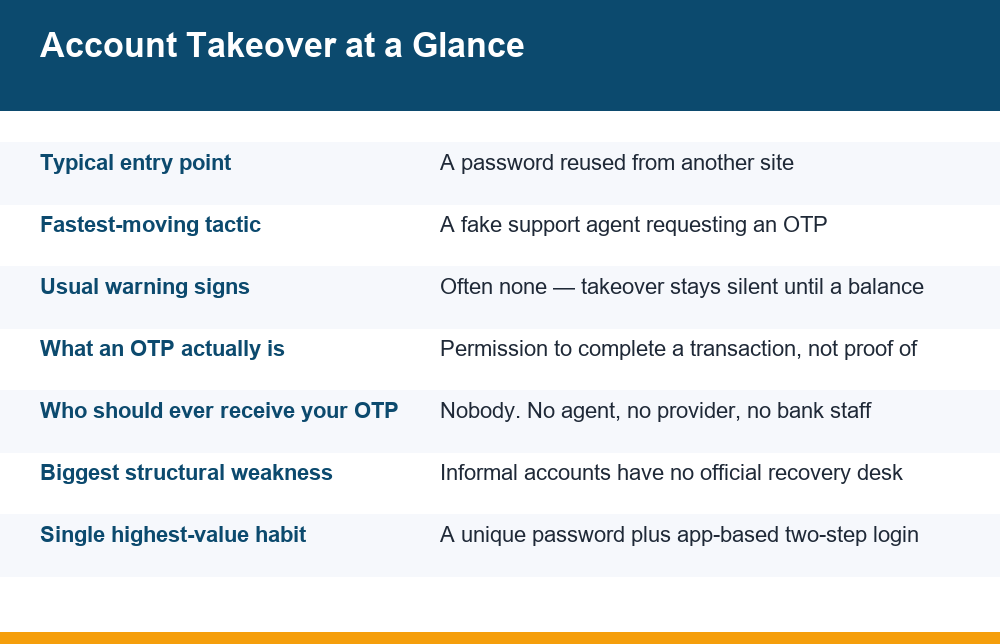
One more framing correction. Account takeover is not an exotic, high-skill event. Almost all of it runs on two commodity techniques: guessing or reusing a password you used somewhere else, and persuading you to read out a code. Neither requires technical sophistication. Both are defeated by boring discipline.
How Do Betting Accounts Get Hacked?
In practice, compromises cluster into four routes. None of them involves anyone breaking encryption or defeating a platform’s servers — they all target the user, because the user is cheaper to attack.
- Credential reuse. A password you also used on a forum, a shopping site or an old email account turns up in a data breach somewhere else. Automated tools then try that same email-and-password pair across hundreds of sites. You did nothing wrong on the betting side at all; the weak link was a site you forgot about years ago.
- Phishing. A message or page that imitates the platform or the provider, built to harvest your login as you type it. Covered in detail in the next section.
- OTP social engineering. Someone already has your username and password, or can trigger a reset, but needs the one-time code sent to your phone. So they call or message you, posing as support, and ask for it. This is the fastest-moving route — often minutes from first contact to drained balance.
- Device-level exposure. A shared phone with the session left logged in, passwords saved in a browser anyone can open, a screen read over your shoulder in a public place, or an app installed from a link rather than an official store. No credential theft required — the account is simply sitting open.
Notice what is absent from that list: clever hacking. The uncomfortable truth behind betting ID account security is that the attacks are unglamorous and the defences are correspondingly unglamorous. A unique password, a second factor that is not an SMS code you might read aloud, and a device nobody else unlocks will neutralise the overwhelming majority of real-world attempts.
There is also a timing pattern worth knowing. Takeover attempts tend to cluster around deposits and around any event that makes you expect a message — a pending verification, a promised adjustment, a balance query you raised yourself. An attacker who messages you while you are already waiting for a message starts with your trust half-granted. Expecting contact is not evidence that the contact in front of you is real.
Should I Ever Share an OTP With Betting Support?
No. Not once, not partially, not “just to confirm the account is yours”, not to a person who already knows your name, your registered number and your last transaction. There is no legitimate scenario in which a genuine support process needs you to transmit a one-time code to another human being.
The reason is mechanical. An OTP is not an identity check. It is an authorisation token — a single-use permission slip for a specific action that a system is already attempting. If a code lands on your phone, something has been initiated: a login, a password reset, a withdrawal, a device registration. Reading that code to someone does not prove who you are. It completes the action they started. That inversion — thinking of the code as proof of identity rather than as a signature on a transaction — is what makes the scam work on intelligent, careful people.
The scripts are recognisable once you have seen them laid out against what is actually happening behind the scenes.
| What the message or call claims | What is actually happening |
|---|---|
| “Read me the code to verify your account” | A login or reset is in progress on someone else’s device |
| “Your withdrawal is stuck, confirm the OTP to release it” | A withdrawal to an unfamiliar destination is awaiting authorisation |
| “We’re upgrading security, share the code to re-register your device” | A new device is being added to your account |
| “Ignore the message text, that wording is a system error” | The genuine warning inside the SMS is being talked over |
| “Bonus credited — confirm the code to activate it” | A transaction, not a credit, is being signed off |
The fourth row deserves emphasis. Almost every OTP message contains its own warning — do not share this code with anyone. Attackers know it is there, so a practised script pre-empts it: the text is wrong, it is automated boilerplate, ignore it. Any person who tells you to disregard the wording inside a security message has told you exactly what they are. End the conversation at that sentence; there is nothing to clarify.
The same rule extends beyond codes. No legitimate process needs your full password read aloud, a screenshot of your login screen, remote access to your phone, or a screen-share while you log in. Betting ID account security survives almost entirely on a single refusal repeated consistently: credentials and codes never leave your own hands.
What Is Phishing in Online Betting?
Phishing is impersonation designed to make you hand over credentials voluntarily. Rather than attacking a system, it builds a convincing replica of something you already trust — a login page, a support handle, a notification — and waits for you to type. In this niche it tends to take four shapes, and they are described here purely so you can spot them, never as something to act on.
- Lookalike login pages. A domain one character off the real one, or a long subdomain that puts a familiar brand name before an unfamiliar host. The page looks correct because it was copied. Whatever you type goes straight to the attacker, often while the page forwards you on to the genuine site so nothing feels wrong.
- Fake verification requests. A message claiming your account is restricted until documents are re-submitted, linking to a form that harvests both ID images and login details. It helps a great deal to know in advance which KYC documents are genuinely requested and which demands should stop you cold, because then an inflated document list reads as a signal rather than as bureaucracy.
- Cloned support identities. A messaging profile with the same picture, a near-identical username and a plausible excuse for the new number — the old account was blocked, the team moved channels, this is the backup line. Being contacted first, from a new number, with an urgent reason, is the pattern.
- Reward and credit bait. A notification about a bonus, a refund or an adjustment that requires you to log in via the supplied link to claim it. The mechanic is explained here only so that the urgency reads as a warning rather than an opportunity.
The common thread is manufactured time pressure. Phishing fails when the target pauses, so every version of it supplies a reason not to: an expiring window, a frozen balance, a limited credit, an account about to be closed. The pause is the defence. Close the message, open the platform yourself the way you normally do, and look. If something real is pending, it will still be pending in five minutes. If nothing is pending, you have your answer.
Fans arriving from a football background are disproportionately exposed, because the whole route in is unfamiliar. When you do not yet know what normal looks like on a cricket-first platform, you cannot tell abnormal from routine — which is precisely why it is worth understanding how football bettors end up holding a cricket ID in the first place before money is involved. Familiarity with the ordinary process is itself a security control.
The 8 Essential Habits Checklist
These are ordered roughly by how much protection they buy per unit of effort. The first three do most of the work.
- Use a password that exists nowhere else. One account, one password, no variations on a theme. This single habit defeats the most common compromise route outright.
- Turn on two-step login, and prefer an authenticator app over SMS. App-generated codes are not transmitted over a network at all, so there is nothing in transit to intercept — and, crucially, they are just as unsuitable for reading out to a caller who has talked their way into your trust.
- Treat every code and password as non-transferable. Nobody receives them. There is no exception for a familiar name, a known number or an agent who already knows your details.
- Never log in through a link you were sent. Reach the platform the way you always do — a saved bookmark or the app you already installed. Links arriving unsolicited are for reading, not for logging in through.
- Keep the betting login off any shared or borrowed device. If a phone or laptop is unlocked by someone else, assume anything logged in on it is accessible to them.
- Give the account its own email address, and protect that email harder than the account. Email is the master key: whoever controls it controls resets. A unique password and two-step login there is not optional.
- Check the account on a fixed rhythm, not only when you want to play. Look at balance, transaction history and any device or session list. Silent takeover is the normal case; you will only find it by looking.
- Keep written records in one place. Dates, amounts, transaction references, screenshots of confirmations. If something goes wrong through an informal channel, the records you kept are frequently the only evidence that exists.
Habit seven is the one people skip, and it is the reason small compromises become large ones. An attacker who gains access rarely empties an account immediately — a slow drain attracts less attention than a single large movement, and a dormant account can sit compromised for weeks. A two-minute check on a predictable schedule turns a silent problem into a visible one.
Habit eight is unglamorous but load-bearing. Strong betting ID account security is partly about prevention and partly about being able to describe precisely what happened, when, and in what amount. Vague recollections are worth very little when you need to explain a sequence of events to anyone; dated records of specific transactions are worth a great deal more.
How Do I Make My Betting ID Password Safer?
Length beats complexity. A long passphrase of four or five unrelated words is generally far harder to crack than a short string tortured with symbol substitutions, and it is easier to remember accurately — which matters, because unmemorable passwords get written down in insecure places or simplified over time. Aim for genuine unpredictability rather than the appearance of it: no names, no birth years, no team, no player, no city, nothing a person who follows your social accounts could assemble.
The harder discipline is uniqueness. A password that is strong but shared across five sites is only as strong as the weakest of those five. If remembering distinct passwords is the obstacle — and it is, for most people — a reputable password manager solves it properly: one strong passphrase protects a vault that generates and stores everything else. The common alternative, saving passwords in a browser on a device others can unlock, achieves convenience without much of the protection.
- Change the password immediately if you ever typed it into a page you reached from a link, even if nothing visibly went wrong.
- Change it if the credentials were ever shared with you over a messaging app and never rotated afterwards — assume that message history still exists somewhere.
- Do not recycle an old password back into use after a gap; treat retired passwords as permanently burnt.
- Do not let anyone ‘set it up for you’ and keep a copy. A credential a second person knows is a credential under joint control.
That last point is a real pattern with informally supplied logins. An account may arrive with a password chosen by whoever issued it, which means the issuer knows it. Changing it at first login — and confirming the registered email and phone number are yours and not a placeholder — is the difference between owning the account and borrowing it. Betting ID account security begins at the moment of handover, not later.
Can Someone Else Withdraw Money From My Betting ID?
Yes, in two different senses, and it is worth separating them because the defences differ.
The first is direct: someone with your login and the ability to pass the second step can move a balance to a destination of their choosing. This is the ordinary consequence of takeover and it is what the habits above are built to prevent. Where a platform allows a withdrawal destination to be changed, that change is the critical moment — if the platform notifies you about a new payment destination or a new device, that notification is not noise. It is the single most important message the account will ever send you, and reading it late is the same as not reading it.
The second is indirect: a balance can be moved by someone who never touches your betting login at all, because the account is only one half of the chain. The other half is the payment method attached to it. Payment credentials — card details, app PINs, UPI authorisation — belong to your bank and payment provider, not to the platform, and no support agent on either side needs them. A request for a payment PIN, a card’s security code, or approval of a collect request you did not initiate is a payment-side attack wearing a betting-side costume.
Two practical separations reduce the damage either way. Keep the money that funds play in an account that does not also hold savings, so that the worst case is bounded. And withdraw rather than letting balances accumulate — a balance left sitting on a platform is both an exposure to takeover and an exposure to every other thing that can go wrong with an informal arrangement. There is no upside to a parked balance you are not using.
A final note that is not a security matter. If play has stopped feeling like a choice — if the checking is compulsive, if losses are being chased, if the account is on your mind when it should not be — the right resource is not a security checklist. Free, confidential help exists, and GamCare’s own description of who it is and what it offers is a reasonable place to start reading.
Shared Devices and Informal Channels: The Hidden Weak Point
Most security advice assumes one person, one device, one locked screen. A lot of real usage looks nothing like that. Phones get handed to family members, laptops are shared in households, logins happen on a friend’s device because a battery died, and sessions stay open for weeks because staying logged in is convenient. Every one of those is a route into the account that requires no attacker at all — just access.
Three specific exposures are worth naming. A session left active means the password and the second factor are both bypassed; whoever holds the unlocked device is already inside. Passwords saved in a shared browser profile can often be revealed through the browser’s own settings by anyone able to unlock the device. And notification previews on a lock screen can display an incoming OTP without the device being unlocked, which quietly converts a second factor into no factor at all.
- Log out fully rather than closing the tab or backgrounding the app, especially on any device that is not exclusively yours.
- Never store the login in a browser profile that another person uses.
- Hide message content in lock-screen notification previews so codes are not visible on a locked phone.
- Install apps only from an official store, never from a link supplied in a chat, and never grant remote-access or screen-sharing permissions to anyone claiming to be support.
- Use the mobile network or a trusted connection for anything involving the account, rather than open public Wi-Fi.
The informal-channel problem layers on top of all of this. When the relationship exists only as a chat thread, there is no verified contact, no ticket number, no audit log and no third party to appeal to. That changes the calculus of betting ID account security in one specific way: you cannot rely on detection and remedy, so everything has to be spent on prevention. In a fully institutional setting, a mistake is usually recoverable. Here, it frequently is not — which is an argument for caution rather than panic, and for keeping exposure small enough that a bad day stays a bad day.
The First Hour After a Compromise, Step by Step
If you believe someone else has access, the order of actions matters more than the speed of any single one. Sequence it like this.
- Secure the email first. Change the email password and confirm its two-step login is active. Email is the reset channel; locking the account while the attacker still controls the mailbox achieves nothing.
- Change the account password, then end all other sessions. If the platform offers a log-out-everywhere or active-device option, use it. A changed password does not always terminate a session already running.
- Re-check the registered details. Phone number, email address, withdrawal destination. Attackers change these early so that future codes and notifications go to them instead of you.
- Secure the payment side separately. Contact your bank or payment provider directly through a number you look up yourself — never a number supplied in a message — if any payment credential may have been exposed or any unrecognised transaction appears.
- Document everything before it scrolls away. Screenshots of the transaction history, the unfamiliar entries, the messages that preceded it, with dates and times. Evidence is easiest to collect in the first hour and hardest to reconstruct later.
- Stop engaging with the person who contacted you. Do not warn them, do not argue, do not try to recover money through them. A second conversation is a second opportunity for them.
Two things not to do. Do not search for a support number and call the first result — fraudulent listings specifically target people in a panic, and the follow-up call is often the larger loss. And do not pay anyone who offers to recover the funds. Recovery-for-a-fee is a known second-stage approach aimed at people who have already been hit once; it is mentioned here only so the offer registers as a warning rather than as help.
The broader point about betting ID account security is that the response plan exists mainly to limit damage, not to undo it. That asymmetry is exactly why the preventive habits are worth the small ongoing inconvenience: a unique password, an authenticator app, a device nobody else unlocks, a refusal to transmit codes, and a bounded amount of money in play. None of it is complicated. All of it has to be in place before anything happens, because afterwards there is very little anyone can do for you.
Frequently Asked Questions
How do betting accounts get hacked?
Overwhelmingly through four commodity routes rather than technical attacks: a password reused from another site that later appeared in a breach, a phishing page or message that captures the login as you type it, social engineering in which someone posing as support persuades you to read out a one-time code, and device-level exposure such as a session left open on a shared phone or passwords saved in a browser others can unlock. Unique passwords, app-based two-step login and a device nobody else unlocks neutralise most real-world attempts.
Should I ever share an OTP with betting support?
No, under any circumstances. A one-time code is not proof of identity — it is single-use authorisation for an action a system is already attempting, such as a login, a password reset, a new device registration or a withdrawal. Reading it to someone completes their action rather than verifying yours. If anyone tells you to ignore the do-not-share warning inside the message, that instruction is itself the proof the contact is fraudulent.
What is phishing in online betting?
Phishing is impersonation designed to make you surrender credentials voluntarily. In this niche it usually appears as a lookalike login page on a near-identical domain, a fake verification or document re-submission request, a cloned support profile messaging you from a new number with an urgent excuse, or bait about a bonus or refund that requires logging in through a supplied link. Every version manufactures time pressure, because pausing defeats it — close the message and open the platform the way you normally do instead.
How do I make my betting ID password safer?
Prioritise length and genuine unpredictability over symbol substitutions: a long passphrase of several unrelated words beats a short complex string. Make it unique to that account, since a shared password is only as strong as the weakest site it is used on, and use a reputable password manager rather than a browser profile on a shared device. If the login was handed to you by someone else, change the password at first use and confirm the registered email and phone number are genuinely yours.
Can someone else withdraw money from my betting ID?
Yes, in two ways. Directly, if they have your login and can pass the second step, which is the ordinary consequence of takeover — notifications about a new device or a changed withdrawal destination are the critical warning to act on immediately. Indirectly, through the payment side, since card details, app PINs and payment authorisations belong to your bank rather than the platform and no support agent on either side ever needs them. Keeping play money separate from savings and withdrawing rather than parking balances bounds the worst case.