Every football weekend produces the same conversation: somebody had five of six and the last leg went down in stoppage time. Accumulator odds are the most heavily promoted product in sports betting and the least favourable to the person placing them, and both of those facts come from the same piece of arithmetic. The headline return is large because the probability of collecting is small, and the operator’s margin on each individual selection compounds across the slip rather than averaging out. None of this makes them irrational to place for fun. It does mean the value is not where the advertising implies, and the six points below explain exactly where it went.
Table of Contents
How accumulator odds are actually priced
An accumulator multiplies the odds of each selection together. Four selections at 2.0 each produce 16.0, and a £10 stake returns £160. That part is straightforward and is usually all that gets explained.
What is left out is that each of those 2.0 prices already contains the operator’s margin. A genuinely even contest should be priced slightly above 2.0 to be fair; it is offered slightly below. That small shortfall is invisible on one selection and is the only thing that matters across four.
The overround, briefly
Convert each price to an implied probability and add them up. On a fair book the total is 100 per cent. On a real one it is 105 or 110, and the excess is the margin. Every selection you add to a slip multiplies by another book carrying its own excess.
Truth one: the margin compounds
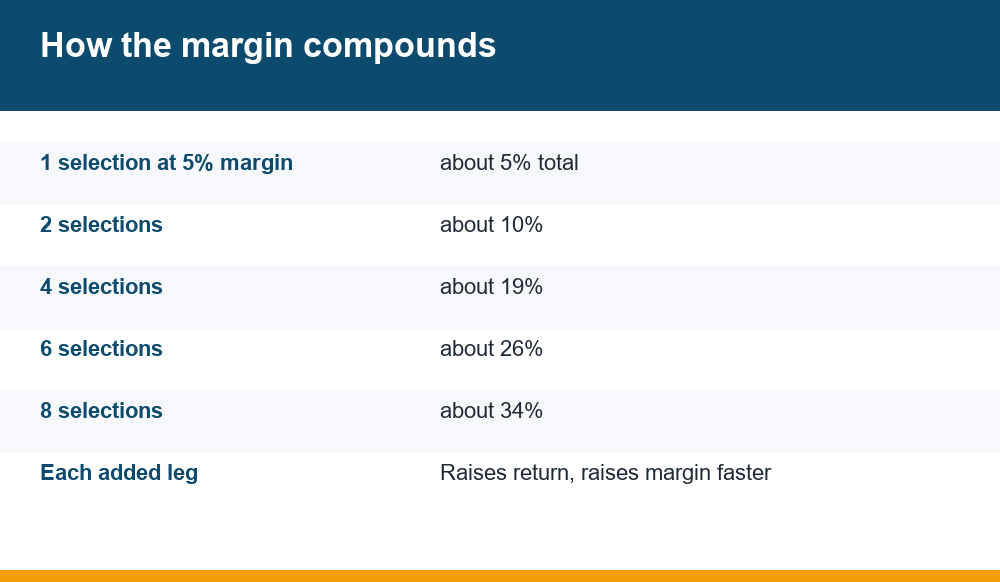
This is the central point and it surprises people who assume the margins average out across legs. They multiply.
With a 5 per cent margin on each selection, a double carries roughly 10 per cent, a four-fold about 19 per cent, and an eight-fold around 34 per cent. By the time a slip has eight legs, a third of its theoretical value has gone before a ball is kicked.
| Legs | Approximate margin | What that means |
|---|---|---|
| 1 | 5% | Standard single bet |
| 3 | 14% | Worse than most casino games |
| 5 | 23% | Worse than roulette by a wide distance |
| 8 | 34% | Comparable to some lottery products |
Viewed that way, the heavy promotion makes sense. Accumulator odds are the highest-margin product on the shelf, and they feel like the best value because the potential return is the largest number on the page.
Truth two: correlation is not what you hope
A common instinct is to build a slip from related outcomes, on the reasoning that if one lands the others probably will too. Backing a strong team to win and also to be winning at half time, for instance.
Operators know this better than anyone, which is why genuinely correlated selections are usually blocked from being combined, or priced as a specific market at odds that already account for the relationship. Where you can combine them, the correlation has been priced in and the apparent edge has gone.
The reverse matters more. Selections that feel independent frequently are not. Six home wins across one league on one afternoon share weather, referee directives and a dozen other common factors, so the real probability of all six landing is not the simple product of the individual ones, and the difference does not work in your favour.
Truth three: the near miss is the product
Five from six is not a bad result that nearly came off. It is the experience the product is built to deliver, and it is delivered reliably.
Because each leg has a decent chance individually, most slips fail by one or two rather than collapsing early. That produces a sustained sense of being close, which is far more engaging than losing outright and considerably more likely to produce another slip next weekend.
There is no manipulation required for this. It falls directly out of the arithmetic of multiplying several likely-ish events together. But it is worth naming, because the feeling of having nearly won is doing real work on the decision to place the next one, and it is not evidence that the strategy almost worked.
Truth four: free bet offers favour the house
Acca insurance, bonus boosts and money-back-if-one-leg-loses offers are the main promotional vehicle in this category. They are not charity, and the terms are where the economics sit.
A refund is almost always paid as a free bet rather than cash, and a free bet is worth meaningfully less than its face value, because the stake is not returned with a win. A £20 free bet at even money returns £20, not £40. Industry estimates put the real value at roughly 70 to 80 per cent of face.
- Minimum odds requirements push you into selections you would not otherwise make
- Minimum leg counts push the slip into higher-margin territory
- The refund is usually capped well below typical stakes
- Free bet stakes are not returned on a win
The offer is genuine in the sense that it does return something. It is also engineered so that taking it costs more in added margin than the refund is worth, which is why these promotions are permanent rather than occasional.
Truth five: cash-out carries its own margin
Cash-out is a genuinely useful feature and a separately priced product. The figure offered is not the mathematically fair value of your position; it is that value minus another margin.
With four legs landed and two to go, the fair value of the slip can be calculated from the current prices. The cash-out figure is reliably below it, often by a wide margin on a multi-leg bet, because the operator is taking a second cut for the convenience.
That does not make it wrong to use. Taking a certain amount instead of an uncertain one is a reasonable preference, and reducing variance has real value to a real person. It is worth knowing that you are paying for it, and roughly how much, rather than treating the number as neutral.
Truth six: it is the same shape as a colour round
For readers who follow both, the structural similarity is worth drawing out, because it is obscured by how different the two look.
A fast colour round and an eight-fold accumulator are both products where a modest stake can return a large multiple, where the probability of that happening is small, and where the operator’s margin is well above what a single straightforward bet carries. One resolves in thirty seconds and the other over a weekend, which changes the experience entirely and the arithmetic not at all.
The football version feels different because it involves judgement. You picked those teams, you had reasons, and the outcome feels earned or stolen. But the margin was applied to each selection regardless of how good the reasoning was, and on a slip of six it has taken a quarter of the value before any of your judgement is tested. We set out the same calculation from the other direction in our piece on where the house edge sits in a colour round.
Using them sensibly, if you use them
None of the above is an argument that nobody should ever place one. A small accumulator across a weekend of matches you were going to watch anyway is entertainment with a known cost, and treating it as such is entirely coherent.
What does not survive scrutiny is treating accumulators as a route to profit, or as better value than singles because the return is larger. The arithmetic runs firmly the other way, and the more legs added the firmer it gets.
- Keep the leg count low. Doubles and trebles carry a fraction of the margin of an eight-fold.
- Stake what the entertainment is worth, not what the potential return suggests.
- Read promotional terms for minimum odds, minimum legs and refund caps before opting in.
- Treat cash-out as a paid convenience rather than a fair valuation.
- Count the near misses honestly; they are the product working, not luck failing.
The single most useful habit is comparing the slip against the same stake placed on one selection. Over a season, the single wins that comparison with striking consistency, and the reason is not luck but the quiet compounding described at the top of this page.
Why accumulator odds differ between operators
Two operators quoting the same six matches will offer noticeably different accumulator odds, and the gap is larger than on singles. The reason follows directly from compounding: a small difference in each leg multiplies out across the slip.
A margin of 4 per cent per selection against one of 6 per cent looks trivial on a single bet. Across six legs it is the difference between roughly 22 per cent and 31 per cent of the theoretical value, which on a large slip is a substantial amount of money that never had any chance of reaching you.
This is the one genuinely actionable point in the whole category. You cannot change the compounding, but you can choose where the slip is placed, and comparing the same six selections across two or three operators takes a couple of minutes. On a slip of any size it is worth considerably more per hour than any amount of thinking about the selections themselves.
- Compare the total returned on the identical slip, not the individual prices
- Check whether a boost applies to the whole slip or only to one leg
- Watch for maximum payout caps, which bite on large multiples
- Note that the most generous single prices rarely sit at the same operator
Maximum payout limits deserve the extra attention. A large accumulator at long odds can exceed an operator’s cap, in which case the advertised return was never available at all, and that detail sits in the terms rather than on the slip.
One last comparison worth making for anyone who follows football closely. The selections on a typical slip are often the ones a knowledgeable fan feels most confident about, which is exactly why the slip gets built in the first place. That confidence is frequently well founded on each individual match and still cannot survive the compounding, because the margin is applied to good judgement and bad judgement alike.
Put differently, knowing football improves your chance of winning each leg. It does nothing whatever to the fee charged on each leg, and on a six-fold that fee has already removed about a quarter of the value before the first whistle. Expertise and margin are separate problems, and only one of them is in your control.
Frequently Asked Questions
Why are accumulators promoted so heavily?
Because the operator’s margin compounds across legs, making them the highest-margin product available. A four-fold built from selections each carrying 5 per cent margin carries roughly 19 per cent overall, and an eight-fold around 34 per cent, while appearing to offer the best value on the page.
Is acca insurance worth taking?
Rarely on its own terms. Refunds are usually paid as free bets worth 70 to 80 per cent of face value, since the stake is not returned on a win, and the minimum odds and minimum leg requirements push the slip into higher-margin territory than you would otherwise choose.
Does adding more selections improve value?
No, it reduces it. Each additional leg multiplies in another margin, so the theoretical value of the slip falls as the headline return rises. Doubles and trebles are far better value than large multi-leg slips, even though they look less appealing.
Should I use cash-out?
It is a legitimate feature and a separately priced one. The figure offered sits below the fair value of your position, often well below on a multi-leg slip. Using it to reduce uncertainty is reasonable as long as you know you are paying a second margin for that.
Are related selections a good way to build a slip?
Genuinely correlated outcomes are usually either blocked or priced as a combined market with the relationship already accounted for. Meanwhile selections that feel independent often share hidden common factors, which makes the true probability of the whole slip lower than the simple multiplication suggests.