The aviator crash game explained in one line: a multiplier climbs upward from 1.00x, a number generated by the server decides in advance exactly where that climb stops, and your only decision is whether to take the multiplier showing on screen before it does. Everything else — the plane, the rising curve, the sound, the scrolling list of other people’s wins — is presentation layered over a single random number. If you arrived here from football betting, that distinction matters more than it first appears, because the interface deliberately borrows the rhythm of a live in-play market while sharing none of its readable inputs. What follows is the mechanical version, with no predictor pitch at the end of it.
Table of Contents
Aviator Crash Game Explained: The Short Answer
Most pages with this game’s name in the title are selling something — a predictor tool, a signal channel, a sign-up link dressed as an explainer. The honest version is shorter and less exciting than any of them, so it gets buried. Here it is.
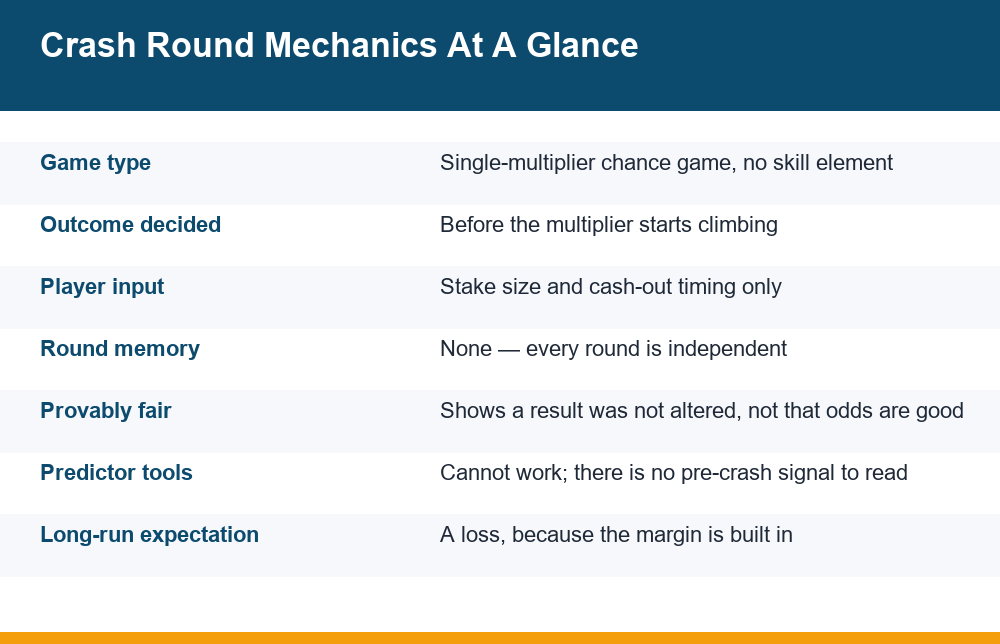
A crash round has exactly one hidden variable: the multiplier at which the round ends. That value is produced by a random number generator before the visible climb begins. The climb itself is an animation playing out a result that already exists. You cannot influence it, read it, or infer it from the rounds that came before, because nothing carries over between rounds. The two levers you hold are how much you stake and when you press cash out, and neither of them changes the odds — they only change the size and shape of the variance you experience.
- The crash point is pre-determined. Not in the sinister sense of being fixed against you personally, but in the literal sense that the number exists before the plane moves.
- Rounds are statistically independent. A run of early crashes tells you nothing about the next round. Neither does a run of high ones.
- There is no observable signal. No pattern on the history strip, no timing trick, no stake sequence reaches the generator.
- The margin is built into the distribution. The spread of possible crash points is shaped so that total stakes exceed total payouts over a large enough sample. That is the product, not a flaw in it.
- Cash-out timing is a risk dial, not an edge. Taking 1.2x often and taking 10x rarely produce different ride quality and roughly the same long-run direction.
If that is all you wanted, you can stop here. The rest of this breakdown is about why the game feels different from what it is, which is the part that actually costs people money. The gap between the mechanics and the experience is not accidental, and it is not small.
How One Round Actually Works, Step By Step
Having the aviator crash game explained at the level of a single round removes most of the mystique. The sequence is fixed and short, and the player’s involvement is confined to two narrow slots within it.
First, a betting window opens for a few seconds. Stakes are accepted and locked. Second, the server derives the round’s crash multiplier from its random inputs. On typical implementations this happens before any visual movement — the result is sitting in memory while the interface is still showing a stationary plane. Third, the multiplier begins to rise along a predetermined curve, accelerating in appearance as it climbs. Fourth, at any point before the stop, a player may cash out and lock the figure displayed at that instant. Fifth, the climb reaches the generated value and halts; every stake still in play is lost. Sixth, the cycle restarts with a freshly generated, unrelated number.
| Stage | What happens | What the player controls |
|---|---|---|
| Betting window | A short window opens and stakes are locked in before the round begins | Stake size, and whether to bet at all |
| Crash point generated | The server derives the round’s stopping multiplier from random inputs | Nothing |
| Multiplier climbs | The display rises along a fixed curve toward the already-decided value | Nothing about the curve or its speed |
| Cash-out | Pressing cash out locks the multiplier shown at that instant | The timing of the press, or an auto cash-out set earlier |
| Crash | The climb stops at the generated value; un-cashed stakes are lost | Nothing |
| Next round | A new crash point is generated with no reference to the previous one | Nothing |
Two design choices deserve attention. The auto cash-out setting removes reaction time from the equation entirely, which tells you something: if reflexes mattered, the operator would not hand you a tool that bypasses them. And the social feed of other players’ cash-outs is a presentation decision, not a data feed you can act on — by the time a win appears there, that round is finished. Both features exist to smooth the experience, and smoothing the experience is what keeps sessions long.
The curve itself is worth a sentence, because its shape misleads people. The multiplier does not rise at a constant rate; it accelerates visually as it goes, so the gap between 1.5x and 2x feels slower than the gap between 8x and 10x. That acceleration is cosmetic. It does not mean the round is more likely to end at a high number, and it does not mean the risk is changing as you watch. The risk was settled before the first pixel moved.
The round is also extremely fast. A football accumulator resolves over ninety minutes or a weekend. A crash round resolves in roughly ten to thirty seconds, which means a player can face more individual decisions in twenty minutes than a weekly football bettor faces in a season. Speed is the most underrated mechanic in the whole category, and it is the one almost never mentioned in promotional explainers. Every one of those decisions carries the same built-in margin, so compressing them together compresses the arithmetic too.
Random Or Rigged? Why Both Words Mislead
“Is it random or is it rigged?” is the question nearly everyone asks, and it is framed in a way that cannot produce a useful answer. The two words are not opposites here. A game can be genuinely random in its outcomes and still be constructed so that the operator keeps a slice of everything staked. Both things are true at once, and the second one is the part that determines what happens to your balance.
Think about how the margin works. The crash multiplier is drawn from a distribution — a shape describing how often low values and high values appear. Low crashes happen far more often than the memorable high ones. That shape is chosen, and the choice is what creates the house edge. Nobody needs to intervene in individual rounds to make the maths work; the maths was settled when the distribution was designed. Expecting a rigging mechanism is looking for a thumb on a scale that was already built at an angle.
The reason the distribution is so easy to misread is memory. The rounds that stop at 20x or 50x are the ones people remember and the ones that get screenshotted and shared, while the far more numerous rounds that stop just above 1.00x leave no impression at all. Human recall is weighted toward the dramatic, and the shape of the distribution is weighted the other way. That mismatch alone explains a great deal of why the game feels more generous than it is.
This is why accusations of rigging and reassurances of randomness often talk past each other. A player on a bad run says the game is rigged because their losses feel engineered. A promotional page replies that the generator is random, which is likely accurate and completely beside the point. The losses were not engineered round by round. They were the expected output of a system whose expected output is losses. Honest framing says so plainly: real-money play of any chance-based game has loss as its mathematically expected result, and nothing in the interface changes that.
The practical takeaway is to stop interrogating individual rounds. Whether round 47 was “fair” is close to unanswerable and almost irrelevant. The distribution is the thing, and the distribution is where the outcome lives. Arguing about one round is arguing about a single coin toss while ignoring the coin.
What Provably Fair Does And Does Not Prove
“Provably fair” is the phrase that does the most work in marketing copy and the least work in reality, so any version of the aviator crash game explained properly has to pull it apart. The underlying idea is real cryptography, not nonsense — but what it verifies is narrower than the name implies.
The standard construction works roughly like this. Before a round, the server commits to a secret value by publishing a hash of it — a fingerprint that cannot be reversed but that uniquely identifies the value. Player-side inputs may be mixed in. After the round, the server reveals the secret. Anyone can hash the revealed secret, confirm it matches the fingerprint published earlier, and recompute the crash multiplier from it. If the numbers line up, the server could not have swapped the result after seeing where the bets landed.
- It does prove that the result was fixed before bets were visible and was not altered afterwards.
- It does prove that the published algorithm, applied to the revealed seed, produces the multiplier you saw.
- It does not prove that the odds are generous, or that the house edge is small, or that the distribution is in any sense in your favour.
- It does not prove that the seed itself was chosen without bias, unless the seeding procedure is itself auditable.
- It does not prove anything at all about the operator’s conduct outside the round — deposits, withdrawals, bonus conditions, account handling.
- It does not help you predict anything, because verification is only possible after the seed is revealed, which is after the round has ended.
That last point is the one worth remembering. The entire mechanism is retrospective by design. If a seed could be used before the round, the scheme would be broken and the game unplayable. So anyone offering a tool that “reads the provably fair seed in advance” is describing something that cannot exist in a working implementation. The phrase is being used as a credibility prop, borrowed from real cryptography to sell its opposite.
It is also worth noticing how rarely anyone actually performs the verification. The procedure requires copying a revealed seed, running it through a hash function, and comparing strings — unremarkable work, but work. In practice the words “provably fair” sit on a page as reassurance and the proof is almost never checked by the people it is meant to reassure. A guarantee nobody exercises functions as branding.
Treat provably fair as a narrow, genuine, useful guarantee about result integrity, and nothing more. It is a lock on one door in a building with several.
Why Predictor Apps And Signal Groups Cannot Work
Search this game’s name and the results fill with predictor downloads, hacked versions, signal channels and “98% accuracy” screenshots. None of them can do what they claim, and the reason is structural rather than a matter of quality. The crash point is generated server-side from data your device never holds. An app running on your phone has access to the animation, the history strip and your own balance. It has no access to the generator. You cannot predict a number from material that does not contain it.
The mechanics of these scams are worth setting out precisely so they are easier to recognise — not because the mechanics are clever, but because they are repetitive. The same playbook circulates across colour-prediction apps, crash games and every other fast chance product, which is why the pattern described in our breakdown of how colour prediction predictor apps actually operate maps onto crash predictors almost line for line.
- Free tool, paid upgrade. A basic version produces vague outputs; accuracy is behind a subscription. The subscription is the product.
- Selective screenshots. Wins are posted, losses are deleted. A channel calling random outcomes will produce winning screenshots by arithmetic alone.
- Split signals. Half a group is told one thing and half another, so whichever way the round goes, a cohort saw a “correct” call and will pay to stay.
- Deposit-first referral links. The tool only “calibrates” after you fund an account through a specific link. The link is where the money comes from.
- Credential harvesting. Many downloads ask for the login to the account holding your balance, or for device permissions far beyond what a calculator needs.
- Remote-control requests. Being asked to install a screen-sharing or remote-access app so someone can “set it up for you” hands over everything on the device.
- Mounting commitment. Early small wins are followed by requests for larger deposits to “unlock” higher multipliers or withdraw a balance that was never real.
There is also a simpler test. If a tool reliably beat the distribution, its owner would use it rather than sell it for a monthly fee, and the operator would notice the drain and shut the market. A working predictor would destroy the game it depends on. The product being sold is hope, priced monthly.
The same logic disposes of the adjacent claims. A “hacked” or “modded” version of the game cannot change a number your device never computes. A paid pattern course is teaching you to read a history strip that contains no information. A bot that automates cash-outs at a fixed multiplier is doing exactly what the built-in auto cash-out already does for free, and neither one shifts the distribution a fraction.
Never install an unofficial application to interact with a real-money balance, never share account credentials with anyone offering a system, and treat any request for remote access to your device as the end of the conversation.
Why It Feels Like In-Play Football Betting
This is the part that matters most for a football audience, and it is why the aviator crash game explained belongs on a site about football betting at all. The crash interface is a very good imitation of cashing out an in-play bet. A number rises, the pressure builds, you decide whether to take the value on the table or hold for more. If you have ever watched a 1-0 lead with twenty minutes left and hovered over the cash-out button, the muscle memory is identical.
The feeling is identical. The substance is not. When you hold or cash an in-play football position, you are weighing real information: who looks tired, who has just come on, whether the away side has shifted shape, how the referee is managing the game. Your read can be wrong, and the market’s margin still works against you, but there is something there to read. In a crash round there is nothing to read, because the answer was written before the round started. The screen simulates a judgement call where no judgement is possible.
| Element | In-play football bet | Crash round |
|---|---|---|
| What you are assessing | Fatigue, tactics, substitutions, weather, team news | Nothing — the result already exists |
| Information advantage | Possible, if you watch closely and know the squads | Impossible; no readable input exists |
| Skill element | Small but genuinely non-zero | Zero beyond stake size and discipline |
| Pace of decisions | Minutes between meaningful moments | Seconds per round, dozens of rounds an hour |
| Feedback loop | Slow enough to reflect between bets | Fast enough to bypass reflection entirely |
| Long-run expectation | A loss, because the margin is priced in | A loss, because the margin is built into the distribution |
Notice what the right-hand column does to the idea of improvement. In football markets a bettor can get better — slowly, unevenly, and never past the margin, but the direction exists. Attention, squad knowledge and patience all have somewhere to go. In a crash round there is no skill curve to climb, because there is no input to get better at reading. Experience buys familiarity with the interface and nothing else.
The crossover risk is specific and shows up in behaviour rather than in anyone’s figures: a bettor who has built real habits around researched, slow, infrequent football positions carries the confidence from that activity into a product where confidence has nothing to attach to. The skills transfer emotionally and not at all mathematically. We looked at that overlap in more depth in our piece on how casino IDs sit alongside football betting accounts, and the single clearest warning sign is a session that began as match-day research and ended somewhere else entirely.
If you want one sentence to carry away: in-play betting rewards attention, and a crash round only rewards the illusion of it.
Losing Streaks, Hot Streaks And The Memory That Isn’t There
“Six early crashes in a row — a big one must be due.” This is the gambler’s fallacy, and crash games are unusually good at producing it because the history strip puts the recent past permanently on screen. A row of red numbers looks like a trend demanding correction. It is not. Each round’s multiplier is generated independently, so the generator has no record of the previous six and no obligation to balance them.
The same error runs the other way. A run of high multipliers feels like a hot table, a session that is “running well”, a moment to increase stakes. That is also independence being misread. There is no momentum in a sequence of unrelated draws. The streak you are looking at is simply what random sequences look like — clustering is normal, and genuinely random data contains more apparent patterns than people expect.
Part of what makes the illusion durable is that the strip is curated by length. It shows the last handful of results, which is far too small a window to reveal a distribution and exactly the right size to suggest a trend. A longer record would look boringly lopsided toward low numbers. A short one looks like a story with a shape.
Where this becomes expensive is in staking responses. Doubling after losses to “recover” assumes a correction is owed, and it is not; the method converts a series of small losses into one large one whenever the run outlasts the balance, which is a matter of when rather than if. Raising stakes during a hot run assumes momentum that does not exist. Both are the same mistake pointed in opposite directions, and neither changes the distribution by a fraction. No staking pattern beats a built-in margin — not progression, not flat betting, not anything in between. The only thing stake sizing controls is how fast the expected outcome arrives.
There is a useful reframe here, and it is the one piece of the aviator crash game explained that changes behaviour rather than just understanding. Stop reading the history strip as information and read it as decoration, because functionally that is what it is. The moment it starts looking like a chart you can interpret is the moment to close the tab.
Mistakes To Avoid, And Where Honest Help Lives
Pulling together everything above, here is the practical residue of having the aviator crash game explained honestly — a list of errors rather than a list of tactics, because tactics are what the promotional pages sell and errors are what actually show up in people’s accounts.
- Treating the history strip as data. It records the past of a system with no memory. There is nothing in it.
- Buying or installing a predictor. At best it is a subscription for randomness. At worst it takes your credentials or your device.
- Reading “provably fair” as “good odds”. It verifies result integrity, not generosity, and only after the fact.
- Chasing with bigger stakes. No progression survives a margin. It only changes the speed and the size of the eventual hit.
- Letting round speed set the session length. Thirty-second rounds mean decisions outrun reflection. Clock time is the only brake that works.
- Importing football confidence. Research skills that genuinely help with a match market have nowhere to attach in a crash round.
- Playing with money attached to something else. Rent, fees, borrowed funds and credit do not belong anywhere near a chance product.
- Chasing bonus or deposit offers. Offers exist to extend play, and conditions attached to them are designed around that, not around your withdrawal.
A short, unglamorous honesty line
Real-money play is for adults only, carries genuine financial risk, and has loss as its expected long-run outcome. That is not a disclaimer bolted on at the end — it is the direct conclusion of everything in the sections above. A product built around a house edge delivers exactly what it was built to deliver.
If the pattern described here feels familiar — sessions running longer than planned, stakes creeping upward, the history strip starting to look meaningful, money moving across from a football bankroll into something faster — that is worth taking seriously rather than optimising. Free, confidential support exists independently of any operator, and BeGambleAware’s advice on safer gambling is a reasonable place to start reading, with no account and no sign-up involved. Speaking to someone outside the activity usually beats any further research into the activity.
For the narrower crossover problem — the idle twenty minutes between kick-offs that turns into an hour of fast rounds — we set out the specific habits worth watching in our breakdown of what happens when casino play fills the gaps between football matches. It is the most common route into this category for sports bettors, and it is the easiest one to interrupt early.
Frequently Asked Questions
How does the Aviator crash game work?
A short betting window opens and stakes are locked. The server then generates the round’s crash multiplier from random inputs, before any visible movement begins. The on-screen multiplier climbs from 1.00x along a fixed curve toward that already-decided value. You may press cash out at any point to lock the figure showing at that instant, or set an auto cash-out beforehand. When the climb reaches the generated value it stops and all un-cashed stakes are lost. The next round generates a brand-new number with no reference to the one before it. Your only inputs are stake size and cash-out timing.
Is the Aviator game random or rigged?
The framing is misleading, because the two are not opposites. The individual outcomes are generated randomly, and nobody needs to interfere with a specific round. The house edge comes from the shape of the distribution the crash multiplier is drawn from — low multipliers appear far more often than the memorable high ones, and that shape was chosen at design time. So the game can be genuinely random and still structured so that total stakes exceed total payouts over a large sample. Losses on a bad run are not evidence of per-round interference; they are the expected output of a system whose expected output is losses.
Can you predict when Aviator will crash?
No. The crash point is generated server-side from data your device never receives, so nothing running on your phone or browser has access to the number. No app, signal channel, pattern on the history strip, timing trick or stake sequence can reach the generator. Predictor products work by selling subscriptions, splitting signals so part of a group always sees a ‘correct’ call, posting only winning screenshots, pushing deposit referral links, or harvesting account credentials and device access. There is also a logic test: anyone with a working predictor would use it rather than rent it out, and its use would end the game it depends on.
What does provably fair mean in Aviator?
It is a real cryptographic commitment with a narrow scope. Before a round the server publishes a hash of a secret seed; after the round it reveals the seed, and anyone can re-hash it, confirm it matches, and recompute the multiplier. That proves the result was fixed before bets were visible and was not changed afterwards. It does not prove the odds are good, that the house edge is small, or that the distribution favours you, and it says nothing about deposits, withdrawals or bonus conditions. Crucially it is retrospective by design — verification is only possible after the round, so it cannot help anyone predict anything.
Does a losing streak make the next Aviator round better?
No. Each round’s multiplier is generated independently, so the system holds no record of the previous rounds and owes no correction. Six early crashes in a row do not make a high multiplier due, and a run of high multipliers does not make the table hot. Clustering is normal in random sequences, and genuinely random data contains more apparent patterns than people expect. This matters because the belief drives staking errors in both directions: doubling after losses to recover converts a series of small losses into one large one whenever the run outlasts the balance, and raising stakes during a good run assumes momentum that does not exist.
Why does Aviator appeal to sports bettors?
Because the interface is a close imitation of cashing out an in-play bet. A number rises, pressure builds, and you decide whether to take the value on the table or hold for more — the same muscle memory as hovering over cash-out on a 1-0 lead. The feeling matches; the substance does not. In an in-play football market you are weighing real information such as fatigue, substitutions and shape, and your read can be right or wrong. In a crash round there is nothing to read, because the answer existed before the round started. The confidence transfers emotionally and not at all mathematically.