A colour prediction referral scheme is the quiet engine behind almost every invitation you receive to a chance-based prediction app, and the single thing most pages on the subject get wrong is describing it as marketing. It is not marketing in any ordinary sense. It is a commission pipeline in which the person inviting you is paid a share of what you stake and lose, for as long as you keep playing. That one fact reframes the whole conversation: the cheerful message sitting in your inbox is not a tip, it is a paid introduction.
What follows is a plain breakdown of how the structure works, who funds it, what the tier language means, and what to check before you reply. For the record: 18+ only, real-money play carries risk, and losses are the expected outcome.
Table of Contents
What Most Pages On A Colour Prediction Referral Scheme Get Wrong
Search this topic and you tend to land in one of two camps. The first camp is written by people earning from the invite link at the bottom of the page: they describe the arrangement as a “community reward”, an “income opportunity”, or a way to “earn while your friends have fun”. The second camp is pure moralising — a wall of alarm with no actual explanation of the mechanism, which is useless to anyone trying to understand the message a cousin just sent them.
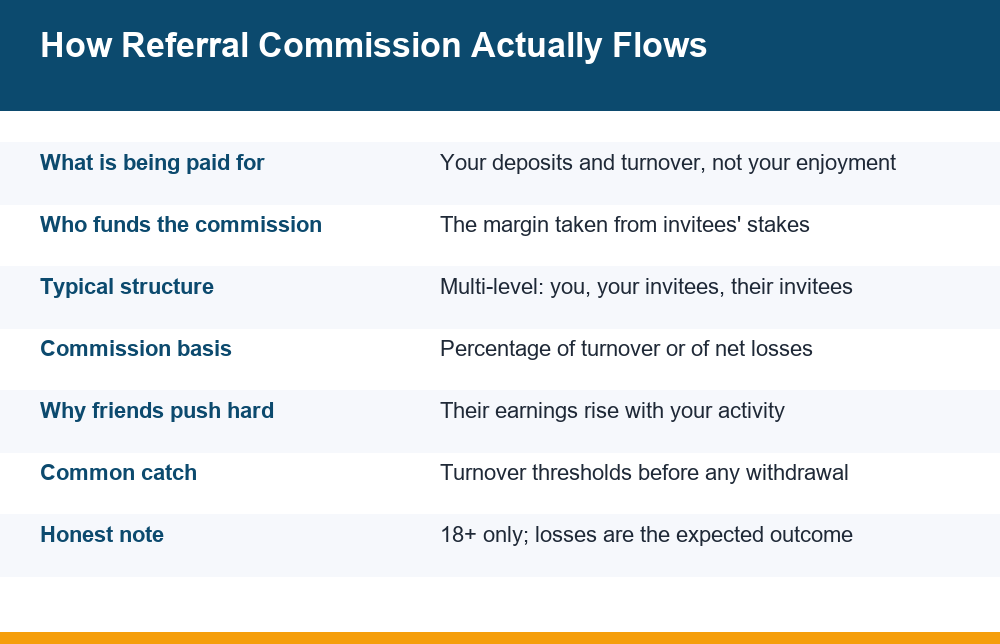
Both camps skip the structural fact that makes everything else make sense. In a colour prediction referral scheme, commission is not paid out of an advertising budget the way a conventional affiliate fee usually is. It is paid out of the house margin collected from the people who were invited. There is no third-party sponsor underwriting it. The money moves in a closed loop: invitee stakes, the operator keeps its cut, and a slice of that cut is routed back up the invite chain.
That distinction matters enormously. A restaurant referral voucher costs the restaurant something, and the restaurant hopes to recover it from a happy repeat customer. Here, the only way the chain generates money is if the invitees lose more than they win over time — which, given a fixed mathematical margin on every round, is the predictable outcome rather than an unlucky one. The scheme does not profit from your satisfaction. It profits from your turnover.
Once you see the loop, the rest of the vocabulary becomes readable. “Agent”, “team”, “level”, “rebate”, “commission rate” and “sub-agent” are not community words. They are the standard language of a recruitment hierarchy, and each one describes a position in the flow of money rather than a role in a friendship.
It also explains why the explanations you receive from inside the structure tend to be vague. A referrer who has been shown a dashboard with a percentage on it has been given a number, not a mechanism. They can tell you what rate they are on. They usually cannot tell you where the money originates, because nothing in the app’s interface says so. That is not evasion on their part so much as an information gap built into the design.
Where The Commission Money Actually Comes From
The commission in a colour prediction referral scheme is typically calculated from one of two bases: total turnover, or net loss. Turnover-based commission pays the referrer a small percentage of every amount the invitee stakes, win or lose. Net-loss-based commission pays a larger percentage, but only of the amount the invitee is actually down over a settlement period. Both arrive at the same destination by different roads.
Turnover-based commission looks gentler because it is not literally labelled as a cut of someone’s losses. The arithmetic undoes the illusion. Every round in these games carries a fixed built-in margin, so staking repeatedly converts a balance into operator revenue at a steady rate. A percentage of turnover is therefore a percentage of a process whose end state is a drained balance. Calling it a turnover rebate changes the label, not the source.
Here is what the money is genuinely paying for, stated without the marketing vocabulary:
- Volume, not loyalty. The payout scales with how much is staked, not how long someone stays or how much they enjoy it.
- New deposits. Many structures add a one-off bonus when an invitee makes a first deposit, which is why the first few messages are usually the most insistent.
- Depth, not breadth. Multi-level structures pay on invitees of invitees, so a referrer is rewarded for teaching others to recruit.
- Retention. Some tiers require a minimum number of “active” members each period, which pushes referrers to chase quiet friends back into play.
- Reinvestment. Where commission credits land in a playable wallet rather than a withdrawable one, the payout quietly returns to the same margin it came from.
None of that requires a conspiracy to be true. It is simply how a closed-loop incentive behaves when the reward is tied to someone else’s spending. Understanding the fixed margin applied to every colour round is the single most useful thing you can do before evaluating any claim about referral income, because the margin is the well that every commission payment is drawn from.
A simple way to sanity-check any pitch is to ask where the money would come from if nobody ever lost. If every invitee broke even forever, there would be no margin to skim, and therefore no commission to pay. A scheme that can only function when its base loses money is not a scheme with an unfortunate side effect. The side effect is the revenue.
Agent Tiers And Rebate Levels, Broken Down
The tier language is where most people lose the thread, partly because apps use slightly different words for the same thing. The underlying design is fairly consistent, though: a flat percentage on people you personally invited, a smaller percentage on the people they invited, and a smaller one again a level below that. Some structures run a handful of levels; others go deeper.
An agent commission in a colour prediction referral scheme is the aggregate of those percentages across your whole downline, usually settled daily or weekly and often gated behind conditions. The table below maps the common terms to what they actually describe. Percentages are deliberately omitted, because they vary between apps and over time, and quoting invented figures would be worse than quoting none.
| Term you will see | What it actually means | What to watch for |
|---|---|---|
| Agent / Partner | A user enrolled in the commission programme | Enrolment is often automatic, without a clear opt-in moment |
| Level 1 / Direct | People you invited yourself | Highest rate, used as the headline number in pitches |
| Level 2 onward / Team | People invited by your invitees, and onward | Rewards teaching recruitment, not playing |
| Rebate | A share of turnover returned periodically | Framed as a discount; funded by the same margin |
| Commission rate | Your percentage at a given tier | Frequently conditional on monthly team activity |
| Active member | An invitee meeting a minimum stake threshold | Creates pressure to pull inactive friends back in |
| Settlement cycle | When commission is credited | Credit may be playable balance, not withdrawable cash |
Two details in that table do most of the damage. The first is the tier condition: a headline rate is usually quoted at the top tier, which requires a team size most people never reach, so the rate an ordinary participant earns is a fraction of the number they were shown. The second is the settlement wallet. If commission lands somewhere it can be staked but not withdrawn, the scheme has not paid anyone — it has extended credit against future losses.
There is a third detail that matters less often but hurts more when it applies: conditions that can be changed. Where the terms allow rates, thresholds or settlement rules to be revised, the arrangement a referrer agreed to is not the arrangement they are necessarily held to months later. Anyone treating an agent position as a dependable stream of income is treating a revisable arrangement as a fixed one, which is a different risk from the one they think they are taking.
Why Friends Keep Inviting You To These Apps
This is the question people actually type into a search box, and it deserves a straight answer rather than a lecture. Your friend is inviting you because the app has made your participation worth money to them. In most cases that is the entire explanation. It does not mean they are lying to you, and it does not mean they set out to profit from you.
What usually happens is more mundane. Someone joins, has an early run of wins — which is unremarkable over a short series of chance-based rounds — and is then shown a dashboard offering a commission rate on invites. The dashboard does not say “your earnings come from your friends’ losses”. It says “share your code and earn”. At that moment the person is not weighing a conflict of interest; they are responding to a reward they have been told is free money, and they genuinely believe the thing they are sharing is good.
The pressure escalates for structural reasons. Where tier conditions require a minimum number of active invitees per cycle, a referrer who drops below the threshold loses the rate they have built. That turns a one-off share into a recurring obligation to chase people. It is why the messages often come in bursts near the end of a month, and why a polite “no thanks” is sometimes met with a second and third attempt that feels out of character.
Group chats accelerate all of this. A shared room where several members already hold commission positions produces social proof that looks organic and is not. If you have noticed these invite rooms circulating through football fan communities, the pattern is the same one: a handful of enrolled agents, a steady drip of screenshots, and a membership that mistakes repetition for evidence.
It is worth separating the two things that are happening in a room like that. One is genuine enthusiasm from people who are still early in their own experience and have not yet met a withdrawal condition. The other is maintenance work by people whose rate depends on the room staying active. From the outside the two look identical, because both produce the same cheerful messages. The difference only becomes visible when you ask what either person has actually taken out.
Are Referral Earnings In Prediction Apps Real Money?
Sometimes, partially, and with conditions — which is a less satisfying answer than either “yes” or “no”, but it is the accurate one. Commission balances shown in a colour prediction referral scheme dashboard are real numbers in the sense that the app has recorded them. Whether they convert into money that reaches a bank account is a separate question governed by the withdrawal terms, and that is where most of the disappointment lives.
The obstacles reported again and again across this category of app are fairly consistent, and they are worth knowing before you count anything as income:
- Turnover requirements. The commission must be staked a stated number of times before any part of it becomes withdrawable.
- Minimum withdrawal floors. A balance below the floor simply sits there, which conveniently encourages staking it.
- Verification gates. Identity checks are commonly introduced at the withdrawal stage rather than at sign-up, which is the point of maximum friction.
- Team activity conditions. Commission may be reduced or frozen if downline activity falls below a stated threshold.
- Wallet separation. Bonus, commission and deposit balances are tracked separately, with different rules attached to each.
The practical test is unglamorous and almost always decisive: has a complete round trip happened? Money in, commission credited, verification passed, withdrawal requested, funds arrived. A dashboard figure proves only the second step. Most of the confident claims circulating in invite rooms stop there, and the people making them have not yet discovered what the remaining steps involve.
There is also a reputational cost that no dashboard displays. Someone who has recruited a dozen friends and then cannot process a withdrawal is holding a social debt, not an asset. That outcome is common enough in these communities that it is worth planning for before you share a code rather than after.
If money has already left an account through a payment flow you do not recognise, or a transfer you did not authorise, the practical step is to report it through the official government channel rather than the app’s own support chat. India’s National Cyber Crime Reporting Portal is the central route for reporting online financial fraud, and acting quickly matters more than acting perfectly. Screenshots, transaction references and dates are the things worth saving first.
Why Recruitment Chains Resemble Pyramid Mechanics
Set the apps aside for a moment and look only at the shape. A structure where participants are paid for enrolling new participants, where payments to upper levels are funded by contributions from lower levels, and where rewards scale with depth of recruitment rather than with the value of anything produced, has a well-understood arithmetic. It is the arithmetic of a widening base that must keep widening.
A multi-level colour prediction referral scheme sits very close to that shape. The difference is that the contribution from the base is not framed as a membership fee; it arrives as stakes placed on rounds with a fixed margin. The effect on the flow of money is similar. Upper levels receive a share of what lower levels surrender, and the only way the upper levels keep receiving it is if the lower levels keep surrendering it or recruit replacements who will.
This is why the numbers are unforgiving for people who join later. Early participants sit above a base that is still expanding, so their commission looks impressive and their screenshots circulate. Later participants sit near the bottom of a chain that has already recruited the obvious candidates in their social circle, so the same percentages generate very little. Nothing about the scheme changed between those two experiences. Only the position did.
The social geometry compounds the arithmetic. Any one person’s reachable network is finite, and the people most likely to accept an invitation — close friends, siblings, teammates — are typically approached first. Recruitment therefore gets harder with every cycle, not easier, while the tier conditions that sustain a rate stay the same or tighten. That mismatch is why enthusiasm in these chains has a shelf life measured in weeks rather than years.
It also explains the specific flavour of optimism in these communities. Attention stays fixed on the top-tier rate and the screenshots, because those are the visible outputs. The invisible input — the aggregate amount lost by everyone further down to fund them — never appears on any dashboard. A structure that displays only its payouts and never its funding source will always look better than it is.
The Conflicted Recommendation Problem
In most other parts of life, a paid recommendation arrives with a label attached. Sponsored posts say sponsored. A reviewer earning from a product usually mentions it. An intermediary taking a cut tends to say so, because the alternative damages their standing. The point is not that paid recommendations are automatically worthless — it is that you cannot weigh one properly without knowing who benefits if you say yes.
An invite to a prediction app arrives with no such label. It comes through a channel built entirely on trust — a sibling, a teammate, a work group — and it carries a financial interest that the sender may not have fully articulated even to themselves. That combination is what makes a referral far more persuasive than an advertisement. You are not evaluating a claim; you are evaluating a relationship, and the claim rides along unexamined.
The useful mental move is to separate the two. Trusting a friend’s character is entirely reasonable. Trusting their assessment of a product they are paid to distribute, in a category where the mathematics guarantees a built-in margin, is a different proposition. You can hold both positions without any accusation: they are not deceiving you, they are simply not a neutral source, and neither would you be after enrolling.
Notice too that the conflict is self-concealing. A referrer who does well early has every reason to attribute it to the app being good rather than to a short run of favourable results, because the second explanation makes their own sharing look careless. Belief and incentive line up, so nobody has to lie for the pitch to be misleading. This is the ordinary way enthusiasm gets manufactured, and it does not require bad intent from anyone in the chain.
People arriving from a sports background tend to underestimate this, because they are used to reasoning about form, fitness and matchups where research genuinely improves judgement. Chance-based colour rounds offer nothing comparable to analyse, which is precisely why the social layer does the persuading instead. It is worth reading what sports bettors specifically tend to misjudge about these apps before assuming that transferable skill exists here. No system beats a fixed margin, and no referral code changes the margin.
Checklist For Reading A Colour Prediction Referral Scheme Pitch
You do not need to argue with anyone or pass judgement on their choices. You need a short set of questions that quietly establishes what is actually on the table. Run through these before replying to the next invite, and the structure of a colour prediction referral scheme becomes visible within about a minute.
- Is there a code or a link? If the invite carries a tracking identifier, the sender has a financial position in your participation. That is the whole question answered.
- Ask directly what they earn. Phrase it neutrally — “do you get something if I join?” Most people answer honestly, and the answer is informative either way.
- Ask whether they have withdrawn. Not whether they have earned. Withdrawn, to a bank account, after verification. The gap between the two numbers is the real story.
- Look for tier conditions. Any mention of “active members”, “team size” or “monthly target” means the sender is under recurring pressure to recruit.
- Check where commission lands. Playable balance and withdrawable balance are not the same thing, and the terms will say which it is.
- Count the levels. If commission flows from invitees of invitees, you are looking at a recruitment hierarchy rather than a one-off thank-you.
- Notice the proof on offer. Screenshots are not records. A dashboard figure demonstrates that a number was displayed, nothing more.
- Ask who else in the room has stopped. Active members are visible; the ones who quietly left are not. An honest answer to that question tells you more than any balance.
If someone close to you is already deep in a recruitment chain, the most constructive thing is usually not a confrontation about the app but a conversation about the obligation. People stay enrolled because stepping back feels like losing a rate they worked for and admitting something to the friends they recruited. Naming that out loud removes more pressure than any argument about probability ever will.
And if the honest answer to “has anyone here actually withdrawn?” turns out to be no, that is not a detail to work around. It is the answer to the entire question, and it was available for free, before any money moved. 18+ only, and losses remain the expected outcome of real-money play however the invitation was framed.
Frequently Asked Questions
Why do colour prediction apps pay for referrals?
Because a referral delivers something an advertisement cannot: a trusted introduction from someone the recipient already believes. The commission is not funded by a marketing budget in the usual sense — it is drawn from the house margin collected on the stakes of the people who were invited. That makes the payout largely self-financing, which is why the advertised rates can look generous. In most structures the app only pays once the invitee has already generated turnover, so the cost is covered before it is incurred.
How does the referral commission work in prediction games?
Commission is typically calculated either as a small percentage of an invitee’s total turnover, or as a larger percentage of their net loss over a settlement period, and it is credited on a daily or weekly cycle. Most structures are multi-level, paying a headline rate on people you invited directly and progressively smaller rates on people they invited, often across several levels rather than one. Rates are commonly conditional on a minimum number of active members per cycle, so the advertised top-tier figure is rarely what an ordinary participant earns.
Why are friends inviting me to colour prediction apps?
In most cases because your participation is worth money to them under the app’s agent programme, often without them having thought it through in those terms. A typical pattern is an early short run of wins, followed by a dashboard offering a commission rate framed simply as “share and earn”. Tier conditions requiring a minimum number of active invitees each period then turn a one-off share into recurring pressure to chase people, which is why the messages often arrive in bursts and why a first refusal is sometimes followed by more.
Are referral earnings in prediction apps real money?
The figures shown are real records inside the app, but converting them into money in a bank account is governed by withdrawal terms that frequently block it. Commonly reported obstacles include turnover requirements that must be met before commission becomes withdrawable, minimum withdrawal floors, identity verification introduced only at the payout stage, team-activity conditions that can freeze a balance, and commission credited to a playable rather than withdrawable wallet. The question worth asking anyone promoting it is not what they have earned but what they have successfully withdrawn.
What is an agent commission in colour prediction apps?
An agent commission is the aggregate payment a user receives for the activity of everyone in their recruitment chain, settled on a fixed cycle. “Agent” or “partner” denotes enrolment in the programme, “level 1” or “direct” means people invited personally, and “team” or “level 2 onward” means invitees of invitees. Rates are tiered and usually conditional, and the structure rewards teaching others to recruit rather than playing — which is what gives the arrangement its hierarchical shape.